
Blog 2026
Sativa Effects: What to Expect (Benefits, Side Effects, and Best Uses)
Oct
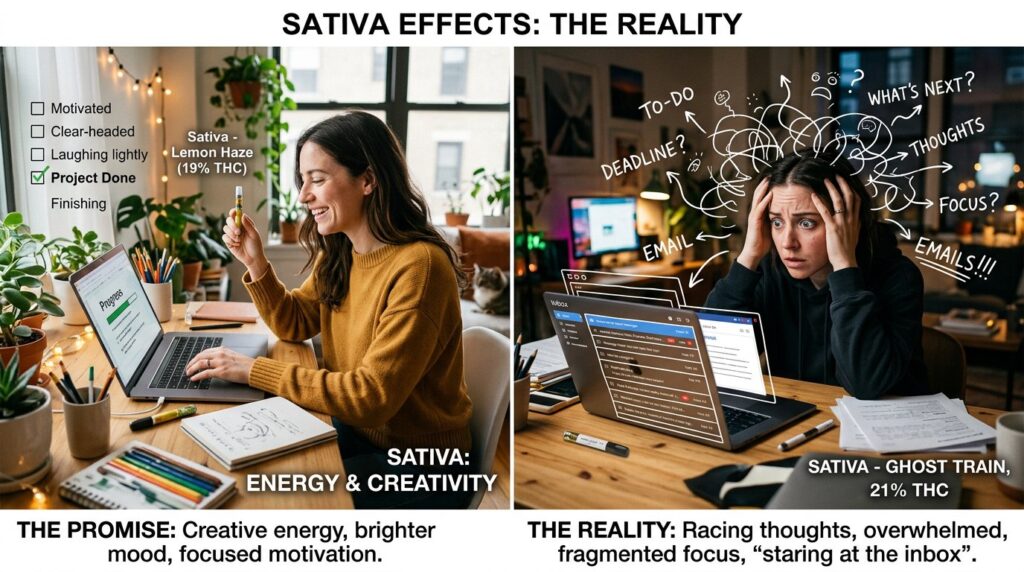
The classic promise of sativa sounds irresistible: a brighter mood, a clear head, and enough motivation to finish the task you’ve been avoiding since Tuesday. But real-world sativa effects aren’t nearly that predictable. One product may make you talkative and creative; another can leave you staring at an overflowing inbox while your thoughts sprint in six directions.
That variation isn’t unusual. “Sativa” is mainly a commercial and botanical label, not a reliable forecast of how cannabis will affect you. Your experience depends more on the dose, THC-to-CBD ratio, terpene profile, consumption method, tolerance, biology, mood and surroundings. Modern strains are also extensively crossbred, which makes simple rules even less useful (our indica vs sativa guide explains why).
This evidence-informed guide explains what you might feel, how long the effects can last, why some people become focused while others feel anxious, and how to read a Canadian cannabis label without needing a chemistry degree. It’s general education for adults in Canada, not personalized medical advice. Products sold outside regulated channels may not match their labels.
A quick safety note before we get into the weeds (yes, that pun was sitting right there): cannabis can impair judgment, coordination and reaction time. Don’t drive, cycle in traffic, operate machinery, or casually combine it with alcohol or sedating medications. If you’re pregnant or breastfeeding, have a history of psychosis or serious heart problems, or take prescription medication, talk to a doctor or pharmacist first.
With that settled, let’s replace the mythology with something more useful: a practical map of the likely benefits, limits and risks.
Key Takeaways on Sativa Effects
- Sativa doesn’t guarantee energy. Product chemistry, dose, tolerance and context predict your experience better than the strain category.
- Commonly reported sativa effects include an uplifted mood, alertness, sociability, creative thinking and a lighter body feel. Sleepiness can still happen, especially at larger doses.
- More THC isn’t automatically better. A high dose can turn useful stimulation into racing thoughts, anxiety, dizziness or poor concentration.
- Timing depends on the format. Inhaled cannabis usually starts within minutes. Edibles may take 30 minutes to two hours, sometimes longer, and can last much of the day.
- CBD may soften some THC effects for some people, but it isn’t a guaranteed antidote. Terpenes may also play a role, though marketing claims often run ahead of human evidence.
- Beginners should choose clearly labelled products, take one small dose in a comfortable setting, and wait before taking more.
- Never buy by strain name alone. Compare THC, CBD, serving size, terpene data and packaging date.
Practical rule: choose chemistry first, format second, and the sativa label third.
Cannabis affects people differently, so treat your first try of any product as a test, not an audition for the Cannabis Olympics. Keep the dose modest, avoid mixing substances, and leave driving for another day.
What Is Sativa? (And What “Sativa-Dominant” Really Means)
Cannabis sativa is a botanical name historically associated with tall, narrow-leaf plants adapted to warm climates and longer flowering seasons. In a Canadian cannabis store or online menu, though, “sativa” generally means a product marketed as mentally stimulating, uplifting or suited to daytime use. It doesn’t confirm a specific chemical makeup. (You’ll find these products grouped in our sativa strains collection.)
“Sativa-dominant” usually describes a hybrid whose genetics, growth pattern or expected effects supposedly lean toward the sativa side. There’s no universal percentage or Health Canada standard behind that phrase. One producer might use it for a 70/30 genetic cross; another may apply it after testers describe the flower as energizing.
Strain names are inconsistent too. Two products called Sour Diesel can differ because of genetics, growing conditions, harvest timing, curing, storage and lab methods. That’s why buying by name alone sometimes feels like ordering a double-double by asking for “the lively one.”
Sativa vs Indica vs Hybrid: What the Labels Can and Can’t Tell You
The labels give a rough idea of how a product is positioned, but their predictive power is limited. For the full comparison, see indica vs sativa vs hybrid.
| Label | Common expectation | What it can’t guarantee |
|---|---|---|
| Sativa | Alert, cerebral, social, creative | Energy, focus or freedom from anxiety |
| Indica | Relaxing, body-heavy, sleepy | Sedation or pain relief |
| Hybrid | Balanced or strain-specific | A precise midpoint between effects |
Research on the chemical and genetic diversity of commercial cannabis has found that strain labels don’t always line up with what’s inside. A 2021 study in Nature Plants, for example, reported that indica and sativa labels did not reflect a clean genetic split, and that the differences people associate with them were linked partly to certain aroma compounds.1
That doesn’t make the labels useless. They can start a conversation with a knowledgeable budtender: “I want something mildly uplifting, not racy.” But the next questions should be about potency, cannabinoids, terpenes and dose. Those details bring you much closer to the experience you actually want.
Common Sativa Effects (Mind and Body)
People often describe sativa effects as “head-forward”: thoughts, senses, mood and conversation may feel more prominent than body heaviness. Yet your response can shift even with the same product. A low dose after breakfast might feel crisp; a larger dose on an empty stomach before a noisy event may feel distinctly less charming.
Mental effects: uplifted mood, focus, motivation, sociability
Common reports include elevated mood, more interest in routine activities, faster associations between ideas and more talkativeness. Music may sound more detailed, jokes may land harder and chores can feel less tedious. Some people find a modest dose helps them start an open-ended activity such as sketching, gardening or brainstorming.
Focus is more complicated. Cannabis may make one subject feel absorbing while reducing working memory and your ability to switch tasks accurately. You might enthusiastically reorganize a drawer while forgetting the report you meant to write. Feeling focused and performing well aren’t always the same thing.
THC can also alter time perception and short-term memory. If precision matters (taxes, exams, client calls, power tools), being interested in the task isn’t enough. You need to stay capable of doing it safely and correctly.
Physical effects: energy, light body buzz, appetite changes
A sativa-marketed product may produce a light tingling sensation, less awareness of minor discomfort, or an urge to move. “Energy” usually means perceived alertness or motivation, not physical fuel. Cannabis doesn’t replace sleep, food, water or coffee, and using it that way can mask fatigue rather than fix it.
Appetite may increase, although not everyone gets the stereotypical munchies. THC interacts with pathways involved in appetite and reward, so ordinary snacks can suddenly seem worthy of a nature-documentary voice-over. Other people notice little change, or even briefly lose their appetite.
Physical effects can also include a faster heart rate, dry mouth, red or dry eyes and impaired coordination. Standing up quickly may make you lightheaded. Sit down, breathe slowly and drink water if that happens.
How fast sativa effects start and how long they last
Delivery method changes the timeline more reliably than the sativa label does. (More detail in edibles vs smoking.)
| Method | Typical onset | Strongest period | Approximate total duration |
|---|---|---|---|
| Smoking (flower, pre-rolls) or vaping | Seconds to 10 minutes | 15–30 minutes | 2–4 hours, sometimes longer |
| Edible or beverage | 30 minutes–2 hours | 2–4 hours | 4–8 hours, with lingering effects possible |
| Sublingual tincture | About 15–45 minutes | 1–2 hours | 3–6 hours |
These are ranges, not appointments. Food, metabolism, dose, tolerance and product formulation can shift them. Swallowed THC is converted in the liver into 11-hydroxy-THC, which can feel stronger and longer-lasting than inhaled THC.
The classic edible mistake is taking another piece after 45 minutes because “nothing is happening.” Then both servings arrive together, like two Ubers you accidentally booked. Wait at least two hours, and longer if you’re inexperienced, before considering more. Our edibles dosing guide covers this in detail.
Potential Benefits of Sativa (What People Use It For)
Adults commonly choose sativa-labelled cannabis for daytime recreation, mood, social ease, creative activities or symptom relief. But “people use it for” isn’t the same as “research proves it treats.” Evidence varies by condition, many studies look at cannabinoids rather than sativa products specifically, and individual responses are highly inconsistent. Health Canada’s information for health care professionals summarizes what is and isn’t established.
Productivity and focus: when it helps vs when it backfires
A small amount may lower the emotional friction around repetitive or creative work. Picture a quiet Saturday: you take a modest dose, put on a familiar playlist and finally repot six neglected houseplants. That kind of low-stakes, flexible task may pair reasonably well with mild effects.
Now swap the plants for a complicated spreadsheet, a ladder or an important negotiation. Changes in memory, judgment and reaction time matter more. A task can feel fascinating while errors quietly multiply.
If productivity is your goal, use a simple checkpoint:
- Choose a low-risk activity that doesn’t involve driving, money, confidential decisions or safety hazards.
- Define one task before consuming.
- Use the smallest practical dose.
- Check your work sober later.
If you regularly need cannabis to start ordinary tasks, pause and look at the underlying issue. Poor sleep, burnout, anxiety, depression or possible ADHD deserve a proper assessment rather than self-treatment by strain label. Our roundups of the best sativa strains for energy and focus and strains for focus and creativity are written with the same caution.
Mood support and stress relief (daytime-friendly options)
Some people report temporary relief from stress or low mood, particularly with lower THC or products with meaningful CBD. The catch is dose: THC can feel relaxing at one level and anxiety-provoking at another, and high-potency products make that line easier to cross.
For a gentler daytime experience, you might compare a balanced 1:1 THC-to-CBD product with a THC-dominant flower. A labelled edible containing 2.5 mg THC and 2.5 mg CBD, for example, gives you much more dosing control than an unmeasured homemade brownie. It may still impair you, but at least the label gives you a usable starting point.
Cannabis isn’t a first-line replacement for therapy, prescribed medication, exercise, social support or sleep. Frequent use can also worsen mood or motivation for some people. If sadness, panic or stress is persistent, talk to your family doctor or a mental health professional rather than continually switching strains. Health Canada’s page on cannabis and mental health is a good starting point.
Creativity and social settings: pairing effects with activities
Cannabis may increase the sense that ideas are novel, loosen associations and reduce self-consciousness. That can suit brainstorming, listening to an album, casual photography or a relaxed dinner with trusted friends (see strains for social nights).
Try separating generating ideas from judging them. Write ideas down while mildly high; evaluate them later when sober. At midnight, “a dating app for houseplants” may look revolutionary. By breakfast… perhaps less so.
Socially, choose familiar company and an easy exit plan. Avoid trying cannabis for the first time at a packed concert, work function or unfamiliar party, where noise and social pressure can amplify overstimulation. And always ask before consuming around others: smoke, vapour, smell and impairment affect more than the person holding the product. Remember that provincial and municipal rules restrict where you can smoke or vape cannabis in public. [VERIFY for your province]
Possible Side Effects and Risks
The most important point is simple: stimulating doesn’t mean harmless. Sativa-marketed products can cause short-term mental and physical side effects, especially when THC potency is high. Longer-term risks depend on how often you use, the age you started, personal vulnerability and product type.
Common unwanted effects: anxiety, paranoia, racing thoughts, dry mouth, dizziness
Unwanted effects can include:
- Anxiety, panic, suspiciousness or paranoia
- Racing or repetitive thoughts
- Short-term memory problems and confusion
- Dry mouth and red or irritated eyes
- Faster heart rate or palpitations
- Dizziness, nausea or poor balance
- Impaired coordination and slower reactions
- Fatigue or a next-day “fog,” particularly after edibles
If you become uncomfortably high, move somewhere quiet and familiar. Sit or lie down, breathe slowly, sip water and remind yourself that the effects are temporary. Don’t try to “walk it off” near traffic, take more substances or drive home. A calm, sober friend can be reassuring.
Call 911 for chest pain, difficulty breathing, fainting, a seizure, severe agitation, suicidal thoughts, persistent vomiting or symptoms that seem dangerous. For advice on a specific case, you can also call your provincial poison centre (1-844-POISON-X / 1-844-764-7669 [VERIFY]). Keep the package nearby so you can say exactly what was taken.
Regular use carries additional concerns. Some people develop tolerance, withdrawal symptoms or cannabis use disorder. Heavy use has also been linked to cannabinoid hyperemesis syndrome, which involves recurring nausea, stomach pain and vomiting. Hot showers may temporarily ease symptoms, but stopping cannabis and getting medical care are the steps that actually help.
Who should be cautious: anxiety sensitivity, new users, high THC
New users and people prone to panic should be especially careful with high-THC flower, concentrates and edibles. A product with 25% THC isn’t “premium” just because the number is large; it’s simply potent. Concentrates can exceed 70% THC and are poor beginner choices. If you’re new, start with a low-THC option.
Extra caution, or avoidance, makes sense if you:
- Have a personal or family history of psychosis or schizophrenia
- Have bipolar disorder, severe anxiety or uncontrolled panic attacks
- Are pregnant, trying to become pregnant or breastfeeding
- Have significant heart or blood-pressure problems
- Take medications that may interact with cannabinoids
- Are under the legal age in your province or territory (19 in most of Canada, 18 in Alberta, 21 in Quebec) [VERIFY], or are a young person whose brain is still developing
- Have had cannabis-related paranoia or vomiting before
Canada’s Lower-Risk Cannabis Use Guidelines [VERIFY URL] cover the same risks around impairment, pregnancy, youth and mental health. Don’t stop prescription medication to try cannabis without medical supervision.
Tolerance deserves attention too. Needing larger and larger doses isn’t proof you’ve mastered cannabis; it can be a sign to cut back or take a break. If cutting down feels hard, speak with your doctor or an addiction professional without shame. This is health care, not a character test.
What Causes Different Sativa Effects? (THC, CBD and Terpenes)
Your experience comes from an untidy mix of chemistry and context. Researchers sometimes call interactions among cannabis compounds the “entourage effect,” but the popular version of that idea is often presented with more certainty than the evidence supports. Product composition matters, and so do expectations, tolerance, setting, sleep and what you ate.
Cannabinoids: THC potency, CBD buffering, minor cannabinoids (CBG, THCV)
THC is the main intoxicating cannabinoid. It can alter mood, perception, memory, coordination and appetite. Dose is crucial: a low dose may feel pleasantly stimulating, while a high dose can produce confusion or panic.
CBD isn’t intoxicating in the same way. Some evidence suggests it may modify certain THC effects, but the result depends on dose and ratio. A tiny amount of CBD in a THC-heavy product shouldn’t be treated as an emergency brake. CBD can also interact with medications through liver-enzyme pathways.
Minor cannabinoids get plenty of marketing attention:
- CBG is often promoted for clarity or focus, but strong human evidence is limited.
- THCV is sometimes described as stimulating or appetite-suppressing. Its effects appear dose-dependent, and most commercial claims go beyond what research can show.
- CBC and others are being studied, but they don’t yet offer dependable effect predictions for shoppers.
Pay attention to milligrams, not just percentages. A 10 mg edible is a defined amount, while “20% THC flower” means roughly 200 mg THC per gram of flower before combustion losses and how much you actually inhale. You won’t absorb all of that, but it shows why deep, repeated inhalations can escalate quickly.
Terpenes linked to “sativa-like” experiences (limonene, pinene, terpinolene)
Terpenes are aromatic compounds found throughout nature. They give cannabis, and lemons, pine needles, lavender and many herbs, their distinctive smells. Certain profiles often show up in products marketed as energizing:
| Terpene | Familiar aroma | Common marketing association |
|---|---|---|
| Limonene | Citrus peel | Bright mood, stress relief |
| Alpha-pinene | Pine, rosemary | Alertness, mental clarity |
| Terpinolene | Floral, herbal, fresh wood | Uplifting or creative effects |
| Beta-caryophyllene | Pepper, cloves | Calm, physical comfort |
| Myrcene | Earthy, musky, mango-like | Relaxation or heaviness |
These associations are hypotheses and user-reported patterns, not guaranteed clinical outcomes. Terpenes may contribute to effects, but concentrations, how you inhale, other compounds and individual sensitivity complicate the picture.
Use aroma as a personal tracking tool. If terpinolene-rich products repeatedly make you jittery, note that. If a limonene-and-caryophyllene profile tends to feel manageable, look for similar profiles next time. Your own log can be more useful than a colourful strain poster, as long as you don’t mistake two experiences for settled science. Familiar sativa-leaning names to compare include Jack Herer, Pineapple Express and Sour Diesel, but check each package’s numbers rather than relying on the name.
When to Use Sativa: Best Times of Day and Situations
The best time depends on the product’s duration, your responsibilities and how you’ve responded before. The word “daytime” on a menu isn’t permission to use cannabis before driving, work, childcare or anything that needs unimpaired judgment.
Morning vs afternoon vs evening
Morning use creates the longest runway for impairment and can encourage repeated dosing. Unless cannabis is part of doctor-guided symptom management, beginners are usually better off testing a product later on a day with no responsibilities. That way you aren’t discovering at 9:15 a.m. that your “focused” strain has made the toaster fascinating.
Afternoon can be more practical if your obligations are done and you don’t need to drive. Leave enough time for the format: inhaled effects may fade within a few hours, while an edible can take up your whole evening.
Evening use is less predictable with sativa-labelled products. Some people unwind; others stay mentally busy and fall asleep later. THC may help you fall asleep at first, but regular use can change sleep quality and lead to rebound sleep problems when you stop. If sleep is the goal, don’t assume a stimulating product will turn sedating because the clock says 10 p.m. (See best strains for sleep instead.)
A sensible first try looks boring, and boring is good:
- You’re at home with no urgent responsibilities.
- A trusted sober person is around.
- You’ve eaten normally and have water nearby.
- You won’t drive until fully sober.
- You know the serving size and have stored the rest safely.
Situations where caution helps: stress, travel, first-time use
Stressful or chaotic surroundings can steer stimulation toward anxiety. Airports, unfamiliar cities, crowded venues, family conflict and high-stakes work are lousy places to test a new product. Cannabis may also heighten self-consciousness if you’re already worried about looking high. (And remember you can’t take cannabis across the Canadian border, even to places where it’s legal. [VERIFY])
First-time users should avoid combining THC with alcohol. The combination can increase impairment, nausea, dizziness and bad decisions, the kind that seem hilarious until someone leaves their phone in a cab.
Take extra care around children and pets. Edibles should stay in their original child-resistant packaging, locked away and separate from ordinary food. Gummies and chocolates don’t look like medication. Never leave a portion on the counter or in an unlabelled bag.
Finally, plan your ride home before consuming. A designated sober driver, transit or an overnight stay beats guessing whether you’re “probably fine.” Feeling normal doesn’t prove your reaction time has recovered, and drug-impaired driving is a Criminal Code offence in Canada. [VERIFY]
How to Choose the Right Sativa for You (Quick Decision Guide)
Start with the experience you want to avoid, not just the one you want. If anxiety is your biggest concern, moderate THC and measurable CBD matter more than finding the most famous sativa. If dose control matters, choose a format with clearly defined servings.
| Your priority | Better starting direction | What to avoid at first |
|---|---|---|
| Mild, manageable experience | Lower-THC flower or balanced THC:CBD product | Concentrates and high-potency vapes |
| Precise dose | Labelled 1–2.5 mg THC edible | Homemade edibles |
| Fast feedback | One small inhalation of tested flower | Repeated hits before effects settle |
| Avoiding smoke | Low-dose edible or tincture | Smoking and vaping |
| Shorter commitment | Carefully paced inhalation | Large edible servings |
No format is risk-free. Smoking exposes your lungs to combustion products; vaping brings device and oil-quality concerns; edibles bring delayed-onset and overconsumption risks.
Beginner dosing: start low, go slow
Health Canada’s advice for new users is “start low, go slow,” and it applies to sativas as much as anything. Our THC dosage guide for beginners goes into more detail.
For an edible, 1–2.5 mg THC is a cautious beginner range. Wait at least two hours, and ideally until another day, before increasing. Five milligrams can be a lot for a new or sensitive person, and 10 mg (the most a legal Canadian edible package can contain [VERIFY]) is not an entry-level dose.
With flower, take one small inhalation and wait 10–15 minutes before deciding whether you need more. Don’t hold smoke deep in your lungs: it adds irritation without reliably improving the experience. Dry-herb vaporizers avoid combustion but still expose your lungs to heated aerosol.
Oil-cartridge vapes are discreet and potent, which makes accidental overuse easy. Avoid modified cartridges or ones from unknown sources: the 2019 wave of vaping-related lung injuries, many linked to THC cartridges containing vitamin E acetate, showed why supply-chain quality matters. Health Canada has published guidance on vaping-related lung illness. [VERIFY: add current canada.ca link] Our guide to buying vape pens online in Canada covers what to check.
Edibles spare the lungs and come with precise labels, but they need patience. Set a phone timer after dosing. Seriously. Memory is exactly what THC can make less dependable.
Reading a Canadian label (and a COA): THC, CBD, terpenes and freshness
Legal cannabis packaging in Canada shows the standardized red THC symbol, a health warning, and the THC and CBD content, including “total THC” and “total CBD.” [VERIFY against Health Canada labelling rules] Some producers also publish a certificate of analysis (COA) from a testing lab, which should match the product’s lot number. Our guide on how to read a cannabis label goes line by line. Check:
- Total THC and CBD: Is it shown as a percentage, mg/g, or mg per unit and per package?
- Serving size: A 100 mg package split into ten pieces has 10 mg per piece, still too much for many beginners.
- Terpene profile: Use it to compare with products you’ve tolerated, not as a medical guarantee.
- Contaminant testing (on a COA): Pesticides, heavy metals, microbes, mycotoxins and residual solvents.
- Packaging date and lot number: Flower generally loses aroma and potency as it ages, and very dry flower can feel harsh. Store it properly to slow that down.
Be skeptical if a package relies on cartoonish promises like “laser focus” but gives you no real potency information. Brand recognition doesn’t replace checking the actual label.
Keep a simple journal: product, lot, dose, time, food, desired effect, unwanted effect and duration. After three or four tries, you’ll have a personal decision guide instead of someone else’s strain folklore.
FAQ: Sativa Effects
What are the effects of sativa?
Sativa effects are usually described as uplifting and “head-forward”: better mood, alertness, chattiness, creative thinking and a light body feel. Common side effects include dry mouth, red eyes, a faster heart rate and, at higher doses, anxiety or racing thoughts. How strong these are depends mostly on THC dose, CBD content, format and your tolerance.
What is sativa?
Sativa is a label for cannabis historically linked to tall, narrow-leaf plants, and today used mainly to market products as energizing or suited to daytime. It doesn’t guarantee a specific chemical profile, so check THC, CBD and terpenes on the label. For how it compares with indica and hybrids, see our indica vs sativa guide.
Does sativa always give you energy?
No. Sativas are often marketed as energizing, but you may feel relaxed, distracted, physically heavy or sleepy. Dose, THC potency, CBD content, terpenes, tolerance, sleep debt and setting all matter. Large doses are especially likely to turn foggy or exhausting once the first lift fades.
If you want an alert experience, choose moderate potency, use a small amount and try it when you’re rested. A strain name can’t negotiate with four hours of sleep.
How long do sativa effects last?
Inhaled, sativa effects usually start within minutes, peak around 15–30 minutes and last about 2–4 hours. Edibles take 30 minutes to two hours to start and can last 4–8 hours or longer. The format matters more than the strain label.
Is sativa better than indica for anxiety?
Not inherently. A stimulating, high-THC sativa may worsen anxiety, racing thoughts or panic. Some people prefer uplifting effects to the heaviness of some indica-marketed products, but that’s personal preference, not a rule.
If you’re anxiety-sensitive, consider a low-THC product with meaningful CBD, use a very small dose and stay somewhere familiar. Avoid concentrates and crowds. Talk to a doctor if anxiety is frequent or disabling: cannabis can complicate symptoms, and evidence-based treatment is more predictable.
Can sativa help me focus?
It may make a task feel more interesting or help some people start creative, low-stakes work. It can also impair short-term memory, accuracy, planning and task switching, so you can feel more focused while actually performing worse.
Use it only for activities where mistakes aren’t dangerous or costly, and review your work sober. Cannabis isn’t an established treatment for ADHD, and self-medicating can delay effective care.
The Bottom Line on Sativa Effects
Sativa effects are best treated as possibilities, not promises. Ignore the race for maximum THC, choose products with clear labelling, and change one thing at a time. Start with a tiny dose in a safe setting, write down what happens, and resist taking more just because the effects haven’t arrived on your schedule.
Your ideal product, if you choose to use cannabis at all, isn’t the one with the loudest name or the highest number. It’s the one that gives you the result you want at the lowest practical dose, with side effects you can live with and no disruption to your safety, sleep, relationships or responsibilities. When you’re ready to compare, browse our sativa strains and sativa-dominant hybrids with the THC and CBD numbers in mind.