
Blog 2026
THC Edibles Dosing Chart: 2.5 mg to 100 mg Explained (2026)
Oct
Walk into any cannabis store, or open any online menu, and you will see edibles labelled with a number: 2.5 mg, 5 mg, 10 mg. That number Cannabis near me is the amount of THC in each piece, and it is the single most useful piece of information on the package. It is also the one that confuses people most.
This guide explains what those milligram numbers mean, how different amounts tend to feel, and how to choose a starting point that suits your experience level. We cover the full range from a 2.5 mg microdose to the 100 mg amounts you may see discussed online. We also explain why a chart can only ever be a rough guide, how to build your own routine, and what to do if you take more than you intended.
If you are new to edibles, read the whole thing. If you are experienced, skip to the dosing chart and the section on tolerance.
What Does “mg of THC” Actually Mean?
THC (tetrahydrocannabinol) is the main compound in cannabis that causes the high. On an edible, the label states how many milligrams of THC are in the product. Two numbers matter, and they are easy to mix up.
Per piece (or per serving). The amount of THC in one gummy, one square of chocolate or one capsule.
Per package. The total amount of THC in everything inside the package.
A package of gummies labelled “100 mg total” may contain ten gummies of 10 mg each, or twenty of 5 mg. Eating the whole bag is a very different experience from eating one piece. Always check how many pieces are in the package and divide.
Canadian limits
Under the Cannabis Regulations, a single package of edibles sold in the legal Canadian market can contain no more than 10 mg of THC in total. That means a legal edible package already tops out at what many guides call a moderate dose. Higher-mg products, such as 50 mg or 100 mg pieces, are not available through licensed edible channels, so if you see them advertised elsewhere, treat that as a red flag about compliance and testing. Always check your provincial rules, since regulations and product categories can change.
Concentrates, tinctures and capsules may be sold in different formats than edibles, so read each label carefully rather than assuming the same rules apply.
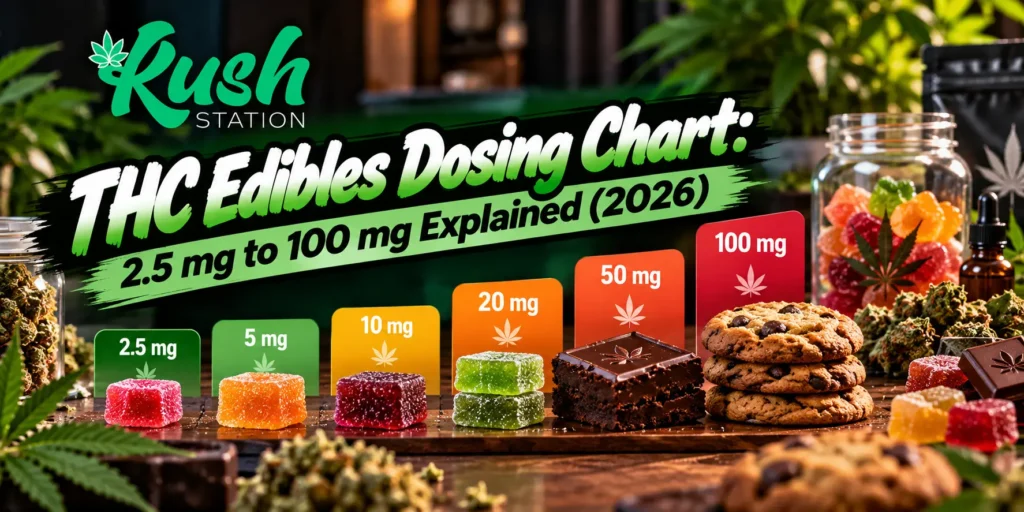
The THC Edibles Dosing Chart
This chart summarizes how different amounts of THC are generally described by cannabis educators and health organizations. These are general tendencies, not guarantees. Your own body, tolerance and circumstances will shape the experience.
| Dose (THC) | Level | Typical Description | Who It Generally Suits |
| 1 to 2.5 mg | Microdose | Subtle, may be barely noticeable; mild shift in mood or relaxation | First-timers, very low tolerance, people who want to stay clear-headed |
| 2.5 to 5 mg | Low | Gentle relaxation, mild mood lift, slight changes in perception | Beginners and occasional users |
| 5 to 10 mg | Moderate | Clear, noticeable high; altered perception, impaired coordination and concentration | Occasional users with some experience |
| 10 to 20 mg | Strong | Intense effects; can feel overwhelming without tolerance | Regular consumers |
| 20 to 50 mg | High | Very strong, long-lasting; high risk of discomfort for most people | People with well-established high tolerance |
| 50 to 100 mg | Very high | Extreme potency; far beyond what most people need or enjoy | Very heavy daily users or specific medical situations under professional guidance |
Reminder: wait at least two hours before taking more, and never combine edibles with alcohol or drive after using them.
A few notes on reading this table.
First, “who it suits” describes the typical match between dose and tolerance, not a recommendation for any individual. A person’s body weight, metabolism and history all matter, and two people of the same size can react very differently.
Second, the ranges overlap on purpose. The border between “low” and “moderate” is blurry, and what counts as a comfortable dose for one person is a heavy dose for another.
Third, the higher tiers exist because some long-term consumers build very high tolerance. That does not mean the amounts are advisable, and it does not mean tolerance makes them harmless. If you are tempted to move up the chart quickly, the safest move is almost always not to.
Dose-by-Dose: What Each Level Is Like
1 to 2.5 mg: The microdose
A microdose is intended to produce effects you notice only subtly, if at all. People who choose this range often want mild relaxation or a slight mood shift without impairment. It is also the most sensible place to start if you have never used an edible, if you are returning after a long break or if you are sensitive to substances in general.
Because the effects are gentle, it can be tempting to assume nothing is happening and take more. Resist that urge. Indica vs sativa A microdose is meant to be understated, and the delay with edibles means it can take well over an hour for its full effect to show.
2.5 to 5 mg: Low dose
This is the range most guides recommend for beginners. Many people experience light relaxation, a slightly improved mood, some changes in how they perceive music or food and mild body comfort. Coordination and concentration may be slightly affected, but most people stay functional in a calm setting.
If you try 2.5 mg and find it comfortable, you can consider a similar amount next time, or inch up to 5 mg on another day. Increasing the dose on a separate occasion, rather than the same evening, gives you clear information about how each amount affects you.
5 to 10 mg: Moderate dose
At this level, the effects are generally unmistakable. Many people report a clear sense of euphoria or relaxation, altered time perception, increased appetite and impaired reaction time. Anxiety is also more likely in people who are prone to it. For occasional users, 10 mg can be a strong experience, and it is the upper limit of what you will find in a single legal Canadian edible package.
Many people who consider themselves experienced with smoking are surprised by how strong 10 mg feels as an edible. See our companion article on why edibles hit differently for the reason, which comes down to how the liver processes THC.
10 to 20 mg: Strong dose
This range is typically for people who use cannabis regularly. For someone with low tolerance, it can produce intense effects, including anxiety, nausea, dizziness, racing heart and confusion. The experience can last many hours.
If you are not a regular consumer, there is generally no benefit to being in this range, and there is meaningful risk of an unpleasant experience.
20 to 50 mg: High dose
At these amounts, effects are powerful and long-lasting for nearly everyone who is not a heavy daily user. Even people with tolerance may find the experience sedating or disorienting. These amounts are not found in legal single-package edibles in Canada.
50 to 100 mg: Very high dose
These amounts are associated with very high tolerance, usually built through daily use over a long time, or in some cases with medical supervision. For the average adult, they are likely to produce an intensely uncomfortable experience, with a higher likelihood of severe anxiety, vomiting, confusion and, in some cases, distressing perceptual changes. They are not appropriate for beginners, and there is no benefit to working up to them casually.
If you find that you regularly need very high amounts to feel an effect, it may be worth taking a tolerance break or talking with a healthcare professional.
Why a Dosing Chart Is Only a Starting Point
A chart is a map, not the territory. Here is why the same number can feel very different from one person to the next.
Tolerance. Regular users need more to feel the same effect. Infrequent users feel more from less.
Metabolism and genetics. The liver enzymes that process THC vary from person to person, so some people clear it quickly and others hold on to it much longer.
Body composition. THC is stored in fat tissue, which influences how it is released over time.
Food in your stomach. Taking an edible with a meal that contains fat can change both the speed and the intensity of absorption compared with an empty stomach.
Product differences. A gummy, a chocolate and a beverage do not behave the same way, and fast-acting formulations can reach the bloodstream sooner.
Mood and setting. Stress, fatigue and an unfamiliar environment can shape how a dose feels.
Label accuracy. In a regulated market, testing helps, but there is still some variation in potency, especially within baked goods or poorly mixed products.
The takeaway is that the chart tells you where to begin, and your own notes tell you where to stay.
Timing: When Will It Hit and How Long Will It Last?
Edibles are processed through the digestive system and liver, so the timeline is slower than smoking or vaping.
| Stage | Typical Timing |
| Onset | 30 minutes to 2 hours |
| Peak effects | Roughly 2 to 4 hours after consuming |
| Total duration | 4 to 8 hours or more |
| Lingering effects | Grogginess or fatigue may last into the next day, especially at higher doses |
These are general ranges, and your own timeline may differ. Fast-acting products may begin sooner but should still be treated with respect.
The two-hour rule
The most common cause of a bad edible experience is taking a second dose too soon. Because onset can be slow, people feel nothing, take more and then experience both doses at once. A widely used guideline is to wait at least two hours before considering more, and many people choose to wait until the next day to adjust.
How to Find Your Own Starting Dose
Here is a simple, cautious way to work out what suits you.
- Start at the bottom. If you are new, consider 2.5 mg or less. If you have some experience but are new to edibles, 2.5 to 5 mg is a common starting place.
- Choose your setting. Pick a calm, familiar place, free from obligations, with no driving required.
- Take one dose and wait. Give it a full two hours at minimum.
- Make notes. Record the product, the amount, what you ate, the time of onset and how you felt.
- Adjust on another day. If you want a stronger experience, increase gradually the next time, not the same night.
- Stop increasing when you are comfortable. More is not better. The goal is an experience you enjoy, not the biggest number.
Common Dosing Mistakes
Eating a whole package. A package may contain several servings. Check the per-piece amount.
Redosing too soon. The delay is the trap. Wait.
Assuming smoking tolerance transfers. Edibles are metabolized differently, so experienced smokers can still be caught off guard.
Mixing with alcohol. Alcohol can intensify impairment, nausea and dizziness.
Taking edibles before obligations. Because the effects are long, edibles are a poor choice before driving, work or caring for children.
Leaving products within reach of kids or pets. Edibles look like candy. Always store them securely.
Special Considerations
Some people should be particularly careful or speak to a healthcare professional before using THC edibles at all:
- People who are pregnant, planning pregnancy or breastfeeding
- People with a personal or family history of psychosis or other serious mental illness
- People with heart conditions
- People taking prescription medications, since THC may interact with drugs processed by the same liver enzymes
- Anyone under the legal age, and young adults whose brains are still developing into their mid-twenties
If any of these apply to you, a doctor or pharmacist can offer advice tailored to your situation.
What If You Take Too Much?
Overconsumption of THC is rarely dangerous for healthy adults, but it can be deeply uncomfortable. Symptoms may include anxiety, panic, a racing heart, dizziness, nausea, confusion and paranoia.
If it happens:
- Stay calm and remind yourself that the feeling is temporary.
- Move to a quiet, comfortable place and have a sober friend nearby.
- Sip water and eat something light if you can.
- Rest. Avoid driving or taking more.
Seek medical help right away if there is chest pain, trouble breathing, fainting, seizures, persistent vomiting or severe confusion. If a child or pet has eaten an edible, call poison control or your local emergency number immediately.
Frequently Asked Questions
What is a good dose for a beginner?
Most guidance suggests starting with 2.5 mg of THC or less, then waiting at least two hours before considering more.
Is 10 mg a lot?
For occasional or new users, yes. It is a moderate to strong dose and the maximum in a single legal Canadian edible package. Regular users often find it comfortable.
Why can’t I buy a 50 mg or 100 mg edible in Canada?
Federal regulations cap THC at 10 mg per package for edibles sold through the legal market.
How long do edibles last?
Usually 4 to 8 hours, with lingering grogginess for some people the next day.
Can I build tolerance quickly?
Tolerance develops with regular use over days to weeks and fades after a break. If you feel you need more and more, consider pausing or speaking with a professional.
What if nothing happens?
Wait at least two hours before considering more. If you still feel nothing, wait until another day to adjust.
Can I mix edibles with alcohol?
It is not recommended. The combination can increase impairment and nausea.
Final Thoughts: Start Low, Go Slow, Take Notes
A THC edibles dosing chart gives you a sensible starting point, but the best guide is your own experience. Begin small, wait patiently, keep notes and adjust one step at a time. Remember that more is not better, and a comfortable experience is always the goal.