
Blog 2026
10 Strongest Weed Strains: How to Choose Safely
Nov
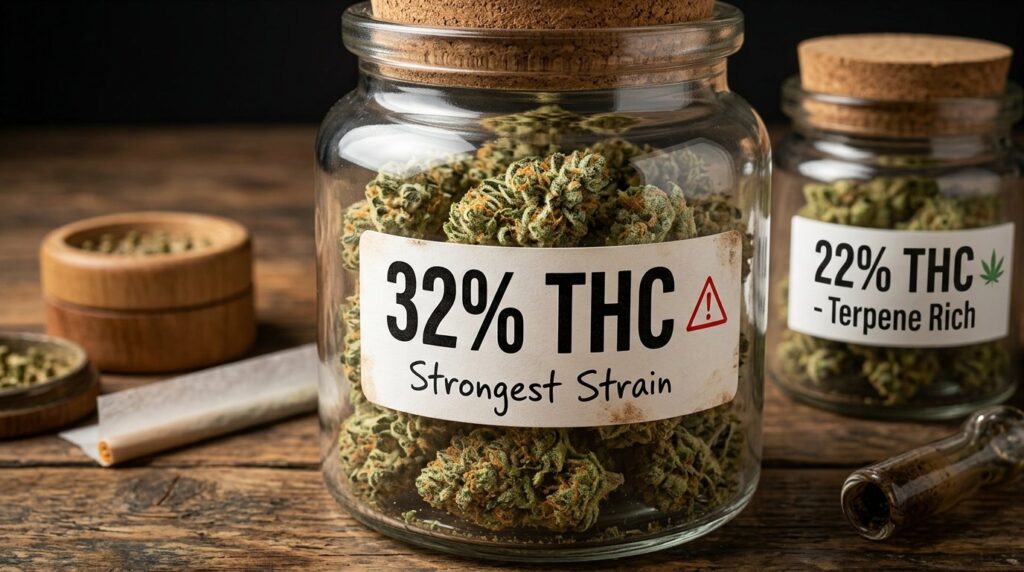
A jar labelled “32% THC” can look like the cannabis equivalent of a warning sign, or a challenge. But that number doesn’t tell you exactly how the flower will feel. One of the strongest weed strains on paper may land with a surprisingly ordinary thud, while a fresh, terpene-rich 22% batch can make the couch feel like it has developed its own gravitational field.
That’s because cannabis potency is messy. Genetics matter, but so do the grower, harvest timing, cure, storage, laboratory methods, your tolerance, and even whether you ate lunch. Strain names aren’t standardized formulas, either. Godfather OG from one licensed producer may differ substantially from a batch carrying the same name in another province.
This review ranks 10 famously potent cultivars using their typical reported THC ranges, reputation, terpene profiles, and commonly described effects. It doesn’t crown a permanent worldwide champion, no honest list can. THC results vary by batch, and exceptionally high label claims deserve scrutiny rather than automatic applause.
You’ll also learn how to read a certificate of analysis, why THCA appears separately from THC, which heavy hitters tend to lean energetic or sedating, and how to reduce the chance that your relaxing evening becomes an anxious three-hour audit of every conversation you’ve had since 2014.
Important: Cannabis laws, including the legal age, differ by province and territory, and high-THC products aren’t risk-free. Avoid cannabis if you’re underage, pregnant or breastfeeding, need to drive, or have medical or psychiatric risk factors that warrant professional guidance. This article is educational and isn’t medical advice. There are no paid product placements or dispensary affiliations in this review.
Key Takeaways
- The strongest weed strains such as Godfather OG, Bruce Banner, GMO, GG4, and Strawberry Banana typically test THC levels between 22–30%, but batch quality and freshness are more important than the strain name alone.
- Terpenes significantly influence the overall potency experience, meaning that a 22% THC strain rich in terpenes can feel stronger than a 30% THC strain with fewer aromatic compounds.
- Reading a batch-specific certificate of analysis (COA) helps verify THC content, terpene profiles, and safety tests, ensuring a trustworthy and enjoyable experience with strong weed strains.
- Start with a low dose of strong cannabis, waiting 10–15 minutes before consuming more, to avoid overwhelming effects and safely gauge individual tolerance.
- Strongest weed strains vary in effects: sativa-leaning strains like Bruce Banner energize, indica-leaning strains like Godfather OG provide heavy relaxation, and hybrids like MAC offer balanced experiences.
- Avoid mixing strong cannabis with alcohol, do not drive while impaired, and use strong strains in a safe, familiar setting to minimize risks and negative side effects.
Key Takeaways: Strongest Weed Strains at a Glance
The quickest answer? Godfather OG, Bruce Banner, GMO, GG4, and Strawberry Banana are among the strongest weed strains commonly found in Canada. Potent batches often test in the mid-20% THC range, while select samples may reach or exceed 30%. Those upper-end figures aren’t guaranteed, and they shouldn’t be your only shopping criterion.
| Strain | Typical reported THC* | General lean | Often chosen for |
|---|---|---|---|
| Godfather OG | 24–30%+ | Indica-leaning hybrid | Heavy relaxation, evening use |
| Bruce Banner | 24–30% | Sativa-leaning hybrid | Euphoria, intensity, creativity |
| GMO | 24–30%+ | Indica-leaning hybrid | Long-lasting body effects |
| GG4 | 23–30% | Hybrid | Powerful euphoria and body heaviness |
| Strawberry Banana | 22–28%+ | Indica-leaning hybrid | Sweet flavour, relaxed mood |
| Wedding Cake | 22–27% | Indica-leaning hybrid | Calm, appetite, rich flavour |
| Ice Cream Cake | 21–27% | Indica-leaning hybrid | Nighttime relaxation |
| MAC | 20–26% | Balanced hybrid | Euphoric, social effects |
| Ghost Train Haze | 22–28% | Sativa-leaning | Cerebral energy and intensity |
| White Tahoe Cookies | 20–27% | Indica-leaning hybrid | Dense body high, winding down |
*Ranges are practical estimates assembled from commonly reported licensed-market results, not fixed genetic specifications.
The big takeaways are simple:
- Batch beats strain name. Check the package date and batch-specific certificate of analysis, or COA.
- THC isn’t the whole experience. Terpenes, minor cannabinoids, dose, and your own biology shape perceived strength.
- Higher isn’t automatically better. A lower dose that produces the effect you wanted is more useful than a heroic dose that ruins your night.
- Beginners should generally skip the potency contest. Strong flower leaves little room for dosing mistakes.
What Makes a Weed Strain “Strong” (Beyond THC %)
People use strong to mean several things: high laboratory THC, fast onset, intense euphoria, heavy sedation, long duration, or simply an experience that overwhelms their tolerance. Those definitions overlap, but they aren’t interchangeable.
A strain can feel powerful because its effects arrive abruptly. Another may start quietly and build into a five-hour body high. Ghost Train Haze’s cerebral intensity and GMO’s physical heaviness are both “strong,” yet they can feel nothing alike.
Your internal variables matter just as much. Frequency of use, recent tolerance breaks, sleep, food, medications, mood, and surroundings can change the result. Inhaling deeply and holding smoke doesn’t unlock secret potency: it mainly increases exposure to irritating combustion products.
Genetics also aren’t a guarantee. Cannabis sold under one strain name can vary among breeders and producers, while different phenotypes of the same cross may express different cannabinoid and terpene profiles. Think of the name as a family resemblance, not a chemical recipe.
THC vs. total cannabinoids (TAC) vs. perceived potency
Most raw flower contains much more THCA than active delta-9 THC. Heat converts THCA into THC through decarboxylation. Because part of the molecule is lost during that conversion, estimated total THC is commonly calculated as:
Total THC ≈ (THCA × 0.877) + delta-9 THC
If a COA lists 27% THCA and 1% THC, estimated total THC is roughly 24.7%, not 28%.
TAC, or total active cannabinoids, may include THC plus CBD, CBG, CBC, and others. Definitions vary by laboratory or jurisdiction, so TAC isn’t always directly comparable between labels. Minor cannabinoids may shape the experience, but research still hasn’t established a reliable formula translating TAC into subjective strength.
Perceived potency is the final, very human layer. A low-tolerance user may find one puff of 18% flower intense: a daily user might barely notice it. Your nervous system doesn’t read the menu board before reacting.
Terpenes and the entourage effect (why some 22% hits harder than 30%)
Terpenes are aromatic compounds responsible for scents such as citrus, pine, pepper, fuel, and earth. Cannabis researchers have proposed that cannabinoids and terpenes may interact, the widely discussed entourage effect, but clinical evidence remains incomplete. You should treat terpene-based predictions as useful clues, not medical certainties.
Still, the aroma profile can help explain why equal-THC batches feel different. Myrcene is often associated by consumers with earthy relaxation: limonene with bright citrus and an upbeat character: pinene with piney alertness: linalool with floral calm: and caryophyllene with peppery warmth. Caryophyllene is unusual because it can interact with CB2 cannabinoid receptors.
A fragrant 22% flower containing 2.5% total terpenes may feel more immediate and distinctive than dry 30% flower with little aroma. That doesn’t prove the lower-THC batch delivers more THC. It means the complete sensory and pharmacological experience can be stronger than one headline number suggests.
Use the terpene panel comparatively: look for dominant compounds you’ve previously enjoyed, then track your response. Your own notes will usually beat a strain stereotype.
Freshness, curing, and storage: potency you can lose
Flower begins changing after harvest. A careful dry and cure can preserve cannabinoids while improving aroma, burn quality, and smoothness. Poorly cured cannabis may smell like hay, feel harsh, or retain too much moisture, conditions that can undermine quality and potentially encourage microbial growth.
Heat, oxygen, and ultraviolet light accelerate degradation. Over time, THC can oxidize into compounds including CBN, although old flower doesn’t magically become a precisely dosed sleep aid. Terpenes are volatile and can disappear sooner, leaving once-pungent buds flat and brittle.
Store flower in an airtight glass container in a cool, dark place. Don’t leave it in a hot car, and skip the freezer unless you have a specific processing reason: frozen trichomes become brittle. Humidity-control packs can help maintain suitable relative humidity, but they can’t resurrect ancient dispensary archaeology.
Check the harvest, packaging, and testing dates. A slightly lower-testing batch packed recently may offer a better experience than a record-setting jar that has spent a year under bright retail lights.
How THC Potency Is Tested (and Why Lab Numbers Vary)
Licensed laboratories generally use high-performance liquid chromatography to separate and quantify cannabinoids. Unlike gas chromatography, HPLC can measure acidic cannabinoids such as THCA without first converting them through heat. That makes it well suited to raw flower.
The instrument may be precise, yet the result is only as representative as the sample. Cannabis plants aren’t chemically uniform. Top colas can differ from lower buds, and one plant can differ from its neighbour. Drying also concentrates compounds by reducing water weight.
Rules vary among jurisdictions, including sampling procedures, allowable variance, contaminant limits, and labelling conventions. Research has also identified concerns about inter-laboratory variability and possible potency inflation. A 2023 Colorado study published in PLOS ONE, for example, found that many retail samples contained less THC than labels indicated, though its findings can’t be generalized to every producer or market.
So read 28.4% as a laboratory estimate for a submitted sample, not a promise that every crumb in your jar contains exactly that concentration.
Flower testing basics: sampling, moisture, and inflated labels
A compliant sampler typically collects material from a production batch and sends it to a licensed laboratory. The lab homogenizes the sample, extracts compounds, and measures their concentrations against reference standards. The key vulnerability is obvious: a small sample stands in for a much larger lot.
Moisture complicates comparisons. Drier flower has less water mass, which can make cannabinoids represent a larger percentage by weight without creating additional THC. Laboratories may report results on an “as received” or dry-weight basis, depending on local rules.
Economic incentives matter too. Consumers often sort menus from highest THC to lowest, rewarding bigger numbers. That can encourage selective sampling, questionable batch definitions, or “lab shopping.” Reputable operators counter this with controlled sampling, accreditation, quality systems, and transparent COAs.
Be skeptical when ordinary flower claims implausibly extreme potency, especially around the mid-to-high 30s. Biological limits, measurement uncertainty, and sampling variation don’t make such results impossible, but they do make verification important. If the flower smells faint and looks tired, a heroic label shouldn’t overrule your senses.
How to read a COA: THC, THCA, TAC, terpenes, contaminants
Open the QR code or batch page and confirm that the COA matches the product name, lot number, and test date. Then inspect these categories:
- Cannabinoids: Find delta-9 THC, THCA, CBD, CBDA, CBG, and calculated total THC. Note whether values are percentages or milligrams per gram: 1% equals approximately 10 mg/g.
- Terpenes: Review total terpene content and the top three compounds. Not every jurisdiction requires this panel.
- Microbials: Look for passing results for regulated organisms, yeast, and mould.
- Pesticides and heavy metals: Confirm “pass” under your jurisdiction’s thresholds.
- Mycotoxins and residual solvents: These are especially relevant to concentrates, though required panels differ.
- Water activity or moisture: Excess moisture can create stability concerns.
Prefer reports from an accredited, licensed third-party laboratory. A polished one-page brand summary isn’t necessarily the full report. If the QR code leads nowhere, the batch numbers don’t match, or contaminants are omitted, ask the retailer before buying.
Top Strongest Weed Strains (Ranked): Effects, Flavour, and Typical THC Range
This ranking balances typical potency, consistency in licensed markets, and reputation, not the single highest test result ever advertised. Exact lineage can vary by breeder, and “indica” or “sativa” labels describe market categories more reliably than they predict individual effects.
Prices vary widely by province, tax structure, producer, and package size. In Canada, an eighth (3.5 g) of legal flower typically runs about $15–$50 CAD, with premium craft batches toward the top of that range, while value-tier flower can cost less. A famous name doesn’t excuse stale inventory, though.
Use this list as a shortlist. At the counter, compare the actual batches available: dates, aroma, cannabinoid panel, terpene profile, cultivation reputation, and contaminant testing all matter more than a strain’s mythology.
1. Godfather OG
Typical THC: 24–30%+, depending on batch
Godfather OG frequently appears at the top of strongest-strain lists because select batches have reported THC around or above 30%. Its exact ancestry is disputed, but OG Kush-family genetics commonly shape its identity.
Expect pungent earth, pine, grape, and spice, often alongside myrcene, caryophyllene, and limonene. Users commonly describe an initial euphoric lift that settles into substantial body heaviness. For someone with modest tolerance, “I’ll just finish this whole joint” can become a tactical error surprisingly quickly.
Godfather OG generally fits an unhurried evening better than a packed daytime schedule. It may appeal if you want a forceful, relaxing experience, but beginners should choose a lower-potency alternative or take one small inhalation and wait. The name is memorable: the COA still decides whether the batch deserves its reputation.
2. Bruce Banner
Typical THC: 24–30%
Named after the mild-mannered scientist behind the Hulk, Bruce Banner is commonly associated with OG Kush and Strawberry Diesel genetics. The joke writes itself: a sweet berry-diesel aroma arrives first, then the green giant shows up.
This sativa-leaning hybrid is often described as fast, euphoric, and creatively stimulating before physical relaxation develops. Limonene, caryophyllene, and myrcene commonly appear in its profile. Unlike heavier nighttime strains, it may feel social or productive to experienced users, but high doses can produce mental racing rather than clean focus.
Choose Bruce Banner if you already understand how stimulating THC affects you. If cannabis sometimes makes you anxious, a highly potent batch may amplify that tendency. Don’t confuse “energizing” with unimpaired: reaction time, judgment, and driving ability can still be affected.
3. GMO (Garlic Cookies)
Typical THC: 24–30%+
GMO, also called Garlic Cookies, is usually identified as a Chemdog and Girl Scout Cookies cross. Its aroma is unapologetic: garlic, fuel, onion, damp earth, and spice. If discreet cannabis is your goal, this is not the jar to open five minutes before company arrives.
Potent GMO batches commonly feature caryophyllene, myrcene, and limonene. Effects are often reported as euphoric, hazy, physically heavy, and unusually persistent. The slow-building character can tempt you to redose too soon, so give it time.
GMO suits experienced consumers seeking a savoury alternative to fruit-and-dessert cultivars. It’s often better reserved for evenings without obligations. Its strength comes from more than THC: assertive flavour, long duration, and dense body effects all contribute to its heavyweight reputation.
4. Gorilla Glue 4 (GG4)
Typical THC: 23–30%
GG4, also sold as Original Glue because of trademark concerns, combines genetics commonly traced to Chem’s Sister, Sour Dubb, and Chocolate Diesel. It became famous for resinous buds and an effect said to “glue” users to the couch.
The aroma combines diesel, sour earth, coffee, and chocolate-like notes. Caryophyllene, myrcene, and limonene are frequent leaders. Many users report a strong euphoric onset followed by increasingly obvious physical relaxation.
GG4 is a versatile heavy hitter, but dose determines whether it feels talkative or immobilizing. One small inhale might accompany a movie: several large hits could make choosing the movie the evening’s most demanding project. Because the name is ubiquitous, quality varies widely. Freshness and producer reputation are particularly important.
5. Strawberry Banana
Typical THC: 22–28%+, with exceptional batches higher
Strawberry Banana is commonly linked to Banana Kush and a strawberry-flavoured phenotype of Bubble Gum. It offers ripe banana, berry, tropical fruit, and creamy sweetness, an approachable flavour wrapped around decidedly un-beginner-friendly potency.
The experience is often described as cheerful and creatively dreamy at first, followed by warm physical relaxation. Myrcene, limonene, and caryophyllene commonly dominate. Its smooth, sweet profile can disguise how much you’ve inhaled, especially in a pre-roll.
This cultivar may work for experienced users who want potency without the aggressive garlic or fuel of GMO and GG4. Measure by inhalations, not by how pleasant it tastes. Dessert still counts, even when it doesn’t taste dangerous.
6. Wedding Cake
Typical THC: 22–27%
Wedding Cake is frequently described as a Triangle Kush and Animal Mints cross, although lineage can differ across breeders and markets. Its vanilla frosting nickname undersells the peppery, earthy, sometimes tangy backbone.
Caryophyllene, limonene, and myrcene often lead the terpene panel. Consumers commonly report an upbeat beginning followed by calm, appetite, and body relaxation. It can feel balanced at a modest dose and considerably more sedating after another round.
Wedding Cake is widely available, which is both useful and confusing. You may encounter excellent indoor flower beside a dry bargain version with the same name. Compare packaging dates and smell when regulations allow. If the aroma resembles cardboard wedding invitations more than cake, keep shopping.
7. Ice Cream Cake
Typical THC: 21–27%
Often bred from Wedding Cake and Gelato #33, Ice Cream Cake is an indica-leaning dessert cultivar known for vanilla, sweet cream, dough, earth, and light citrus. Typical terpene leaders include caryophyllene, limonene, and linalool or myrcene.
The strain’s reputation centres on soothing physical heaviness and a slower, quieter headspace. It’s generally a better match for a low-demand evening than a morning full of spreadsheets and human interaction.
Ice Cream Cake can be potent without feeling as mentally sharp as Ghost Train Haze, but that doesn’t make it beginner-proof. Its relaxing build may encourage premature redosing. Take a small inhalation, let the effect develop, and keep snacks within a reasonable walking distance.
8. MAC (Miracle Alien Cookies)
Typical THC: 20–26%
MAC, short for Miracle Alien Cookies, is often associated with Alien Cookies, Colombian, and Starfighter genetics. It’s prized as much for its dense, frosty appearance and complex aroma as for raw potency.
Expect citrus, floral notes, musk, earth, and a touch of fuel. Limonene, caryophyllene, and pinene commonly feature. Many users find MAC euphoric, talkative, and physically comfortable, a balanced profile that can still become intense at higher doses.
MAC earns its place because perceived quality isn’t a race to 30%. A fresh 23% batch with loud terpenes may offer a more vivid experience than a tired, higher-testing competitor. It’s a strong candidate for experienced users seeking potency without automatic couch-lock.
9. Ghost Train Haze
Typical THC: 22–28%
Ghost Train Haze, commonly linked to Ghost OG and Neville’s Wreck, is the cerebral outlier in this ranking. Its aroma tends toward lemon, pine, herbs, and floral haze, with terpinolene, limonene, and pinene often playing major roles.
Users frequently describe a rapid, energetic head high, heightened sensory awareness, and creative momentum. At higher doses, that same momentum can become scattered thinking, unease, or paranoia. Potency isn’t always a weighted blanket: sometimes it’s 14 browser tabs opening at once.
This strain is best suited to experienced consumers who enjoy stimulating cannabis and already know they tolerate it. If you’re prone to panic or racing thoughts, a lower-THC, CBD-balanced option is likely the smarter choice.
10. White Tahoe Cookies
Typical THC: 20–27%
White Tahoe Cookies is generally associated with The White, Tahoe OG, and Girl Scout Cookies genetics. It brings together earthy OG fuel, nutty sweetness, citrus, and pepper, often supported by caryophyllene, limonene, and myrcene.
Its effects are commonly characterized as euphoric at the beginning and deeply relaxing as time passes. Compared with Ghost Train Haze, the experience usually leans more physical and less electrically cerebral.
This is a solid evening choice for users who want layered flavour and a dense body high without chasing the largest THC number on the shelf. As with other Cookies-family names, market versions differ. Let the batch data, and your nose, break the tie.
Strongest Weed Strains by Type: Best Sativa, Indica, and Hybrid Heavy Hitters
The traditional sativa-indica-hybrid system is convenient, but it’s a rough shopping shorthand rather than a precise scientific forecast. Most modern cultivars are genetically hybridized, and studies have found that commercial labels don’t consistently map onto genetic similarity.
Still, the categories can describe the style of experience consumers expect. Sativa-leaning usually means more cerebral or energizing: indica-leaning suggests heavier physical relaxation: hybrid implies some balance between the two.
For better predictions, combine the category with the batch’s cannabinoid and terpene data, then factor in your previous responses. Two people can share the same joint and write very different reviews afterward.
Strongest sativa-leaning strains (energy, intensity, head-high)
Ghost Train Haze and Bruce Banner are the standout sativa-leaning choices in this ranking. Ghost Train Haze tends to deliver the sharper, more atmospheric head high, while Bruce Banner often adds more noticeable physical grounding.
Other potent sativa-leaning names you may encounter include Durban Poison, Super Lemon Haze, Jack Herer, and Sour Diesel, though typical THC varies considerably. Don’t dismiss a 20% Durban Poison simply because a nearby hybrid claims 29%: terpinolene-rich flower can feel strikingly vivid.
These strains may suit music, art, hiking in a safe setting, or social conversation. They’re less attractive if THC already gives you racing thoughts. Use them early enough that stimulation won’t sabotage sleep, and never treat “daytime strain” as permission to drive or operate equipment.
Strongest indica-leaning strains (body load, sedation, couch-lock)
For pronounced body effects, Godfather OG, GMO, Ice Cream Cake, and White Tahoe Cookies are strong indica-leaning candidates. Wedding Cake and Strawberry Banana can also become heavy at larger doses.
The practical difference is flavour and pacing. GMO tends to be savoury and long-lasting: Ice Cream Cake is sweeter and often calmer: Godfather OG may feel more immediately forceful. If you’re selecting for bedtime, look for batches rich in myrcene, linalool, or caryophyllene, but remember that terpene associations aren’t guarantees of sleep.
Strong indica-leaning flower can cause next-morning grogginess, especially when used late or heavily. Start earlier than bedtime on your first trial. You want to learn its timing when tomorrow’s alarm isn’t waiting to judge you.
Strongest hybrid strains (balanced but powerful)
GG4, MAC, Bruce Banner, and Wedding Cake illustrate how broad the hybrid category is. MAC may stay sociable at a modest dose, whereas GG4 can slide quickly toward couch-lock. Bruce Banner leans cerebral: Wedding Cake often becomes more physically soothing.
A balanced hybrid makes sense when you don’t want either extreme. For a relaxed dinner with friends, a small amount of MAC may fit better than sedating GMO or high-octane Ghost Train Haze. For a movie night, GG4 could be more appropriate, provided nobody expects you to assemble furniture afterward.
Dose changes the category’s meaning. Many “balanced” strains feel upbeat after one inhalation and heavy after four. Review your past purchases and identify the combinations of dose and dominant terpenes that worked, rather than repeatedly gambling on names.
Effects of the Strongest Strains: What to Expect (and Who Should Avoid Them)
High-THC cannabis can alter attention, memory, coordination, reaction time, time perception, and judgment. Desired effects may include euphoria, laughter, sensory enhancement, appetite, and relaxation. Unwanted effects can include dry mouth, dizziness, nausea, anxiety, confusion, or panic.
Risk rises with dose, low tolerance, rapid consumption, and products with delayed onset. Younger people, pregnant or breastfeeding people, and anyone driving should avoid cannabis. Extra caution, or avoidance, is appropriate if you have a personal or family history of psychosis, bipolar disorder, serious cardiovascular disease, or problematic substance use. Discuss cannabis with a qualified clinician who understands your health history and medications.
High potency also appears relevant to dependence and mental-health risk. Health Canada’s overview of cannabis and your health summarizes current evidence and uncertainties. “Natural” doesn’t mean consequence-free.
Common effects: euphoria, time distortion, heavy body high
With strong flower, the first noticeable change may be mood: music feels richer, conversation becomes funnier, or routine thoughts seem unusually fascinating. Short-term memory can become unreliable, which is how you may find yourself reopening the refrigerator without remembering the mission.
Time distortion is common. Ten minutes may feel much longer, particularly when you’re waiting to decide whether the dose was “enough.” That perception makes patience essential.
Indica-leaning heavy hitters may produce limb heaviness, warmth, appetite, and reduced motivation. Stimulating strains can heighten colours, sound, and internal dialogue instead. Effects from inhaled flower usually begin within minutes, peak relatively quickly, and taper over several hours, though impairment can last longer depending on dose and the individual.
Plan the setting before consuming: finish responsibilities, arrange transportation, keep water nearby, and choose familiar company.
Anxiety/paranoia risk, heart rate, and impairment
THC can temporarily increase heart rate and trigger anxiety, suspicious thinking, or panic, especially at high doses. The uncomfortable loop often sounds like this: you notice your heartbeat, worry about noticing it, and then notice it even more.
Move to a quiet place and remind yourself that the effects are temporary. But don’t dismiss serious symptoms. Seek urgent medical help for chest pain, trouble breathing, fainting, seizure, severe confusion, dangerous behaviour, or inability to wake someone.
Cannabis impairs driving-related skills even when you feel confident. Don’t drive, cycle in traffic, use power tools, or supervise risky activities while impaired. Arrange a sober ride before consuming.
People with low tolerance and those prone to anxiety should avoid the strongest weed strains or choose lower-THC products containing meaningful CBD. CBD isn’t a guaranteed antidote, but balanced THC:CBD products may feel less intense for some users.
How to Choose the Strongest Weed Strains for Your Tolerance and Goals
Start by replacing “What’s strongest?” with “What outcome do I want?” The answer might be quiet relaxation, a social lift, appetite, creative play, or sleep. Then choose the lowest potency likely to accomplish it.
A practical dispensary checklist:
- Confirm the batch-specific total THC and dominant terpenes.
- Check packaging and harvest dates.
- Ask how the flower was stored.
- Choose whole flower over an old pre-roll if freshness is uncertain: pre-rolls can hide lower-grade or dry material.
- Buy a small quantity before committing to an ounce (28 g).
- Record the product, dose, onset, duration, and outcome.
If you use cannabis frequently but need ever-larger doses, consider a tolerance break rather than escalating to concentrates. Difficulty cutting back, persistent cravings, or continued use even though harm can signal cannabis use disorder and deserves nonjudgmental professional support.
Pick by terpene profile (sleep, focus, mood, appetite)
Terpene shopping works best as pattern recognition, not prophecy. Use these associations as starting hypotheses:
| Goal | Profiles worth exploring | Strong examples |
|---|---|---|
| Wind down | Myrcene, linalool, caryophyllene | Ice Cream Cake, Godfather OG |
| Brighter mood | Limonene, caryophyllene | Bruce Banner, Wedding Cake |
| Alert, cerebral feel | Terpinolene, pinene, limonene | Ghost Train Haze |
| Appetite and body comfort | Myrcene, caryophyllene | GMO, GG4 |
Terpenes alone don’t determine outcomes, and claims about treating insomnia, depression, ADHD, or pain require more evidence than a dispensary label provides. Your dose and THC sensitivity remain central.
Try one variable at a time. If a limonene-forward strain felt pleasant, compare another at a similar THC level and dose. After three or four trials, your notes may reveal whether citrus-heavy profiles genuinely suit you, or whether you simply liked one excellent batch.
Start low, go slow: dosing guidance for flower vs concentrates vs edibles
For potent flower, a new or low-tolerance user can take one brief inhalation, then wait at least 10–15 minutes before considering more. Avoid deep inhalation or breath-holding. A dry-herb vaporizer can make small doses easier to control and avoids combustion, though inhalation still carries risks.
Concentrates commonly contain 60–90% THC and are much less forgiving. If you’re inexperienced, skip dabs and high-output vape devices until you understand your response to flower.
Edibles are a different category. Effects may take 30 minutes to two hours, or longer, to appear and can last six hours or more. Beginners commonly start around 1–2.5 mg THC: 5 mg may already feel substantial. Wait at least two hours, preferably longer, before adding more. A 10 mg gummy isn’t automatically one beginner serving.
Never calculate edible potency from flower casually at home: extraction and decarboxylation introduce uncertainty. Use clearly labelled products that state THC per serving.
Safety Tips for Using Very Strong Weed
The safest way to avoid an overwhelming high is to use less THC, or not use it. If you do choose a very strong strain, treat preparation as part of the dose.
Use cannabis in a familiar, low-pressure place with trusted people. Secure products away from children and pets, ideally in a locked container with original labelling. Don’t share mouthpieces when illness is circulating, and avoid improvised smoking devices made from plastic or coated metal.
High-THC use shouldn’t be your first experiment before a flight, concert, family gathering, or anything involving security lines and complicated feelings. Try an unfamiliar batch at home on an obligation-free evening.
And budget for quality rather than THC alone. Spending $50 on a premium eighth isn’t sensible if it’s old, poorly stored, or missing credible contaminant results. Safety data and freshness deliver more value than a flashy percentage.
Harm reduction: hydration, setting, and avoiding mixing with alcohol
Eat a normal meal, hydrate, and decide your dose before starting. Water won’t make you sober, but it can ease dry mouth and prevent ordinary dehydration from adding to discomfort. Keep simple snacks nearby and choose a calm environment where you can sit or lie down safely.
Avoid combining cannabis with alcohol. The mixture can increase dizziness, nausea, poor coordination, and impairment: drinking first may also intensify THC exposure. Be cautious with sedatives and other medications, and ask a pharmacist or clinician about possible interactions.
A sober friend is useful when you’re trying a potent product. Tell them what you used and approximately how much. Keep the package available so responders can identify the product if necessary.
Finally, put the car keys away before consuming. Decision-making gets less reliable after THC arrives, which is rather inconvenient timing.
What to do if you get too high (step-by-step)
If the strongest weed strain turns out to be much stronger than expected, follow this sequence:
- Stop consuming. Don’t try to “even it out” with alcohol or another drug.
- Move somewhere quiet and safe. Sit or lie down away from stairs, traffic, water, and other hazards.
- Slow your breathing. Inhale gently for four counts and exhale for six. Repeat without forcing it.
- Orient yourself. Say where you are, what you took, and that the effects will pass. Check the clock sparingly: staring at it can make distorted time feel worse.
- Sip water. Have a light snack if that feels comfortable, but don’t expect food to instantly reverse intoxication.
- Contact a trusted sober person. Ask them to stay nearby or remain on the phone.
- Get expert help when needed. In Canada, call your local poison centre at 1-844-POISON-X (1-844-764-7669) (in Quebec, 1-800-463-5060) for case-specific guidance. Call 911 for severe symptoms such as chest pain, difficulty breathing, seizure, collapse, extreme agitation, or psychosis.
Peppercorns, lemon peel, CBD, and cold showers are popular internet remedies, but none is a dependable reversal method. Don’t create additional risk chasing a hack.
The practical conclusion is less glamorous than a potency leaderboard: the best of the strongest weed strains is the batch that matches your tolerance, desired effect, and setting while passing credible safety tests. Godfather OG and GMO may suit experienced users seeking a heavy evening experience: Bruce Banner or Ghost Train Haze may appeal to those who tolerate cerebral intensity: MAC can offer a more balanced route.
Check the COA, prioritize freshness, take one small dose, and wait. You can always consume more later. You can’t negotiate with the edible, or the enormous joint, you already finished.
Frequently Asked Questions About the Strongest Weed Strains
What are the strongest weed strains commonly available in Canada?
Among the strongest weed strains are Godfather OG, Bruce Banner, GMO, Gorilla Glue 4 (GG4), and Strawberry Banana, often testing THC levels in the mid-20% range, with some batches reaching 30% or higher.
How does the THC percentage affect the potency of a cannabis strain?
THC percentage indicates potential potency, but perceived effects depend on factors like terpenes, batch quality, your tolerance, and consumption method. Thus, a lower-THC, terpene-rich strain may feel stronger than a higher-THC one.
Why should beginners avoid the strongest weed strains?
Strong weed strains can cause intense effects, including anxiety and impaired judgment, especially for beginners. Starting with lower potency allows safer dosing, reducing risk of unpleasant experiences.
How do terpenes influence the effects of strong cannabis strains?
Terpenes like myrcene, limonene, and caryophyllene interact with cannabinoids to shape effects such as relaxation, mood elevation, or energy. They contribute to the overall ‘entourage effect,’ making some 22% THC strains feel more potent than 30% THC strains with fewer terpenes.
What is a Certificate of Analysis (COA) and why is it important?
A COA is a lab report showing cannabinoid levels, terpenes, and contaminants for a cannabis batch. Checking the COA ensures you get accurate potency info and safe, quality flower rather than relying solely on strain names or THC claims.
How should I dose when trying a strong cannabis strain for the first time?
For potent flower, begin with one small inhalation and wait 10–15 minutes before more. Avoid deep inhales or breath-holding. For edibles, start low (1–2.5 mg THC) and wait at least two hours before increasing dose to avoid overwhelming effects.