
Blog 2026
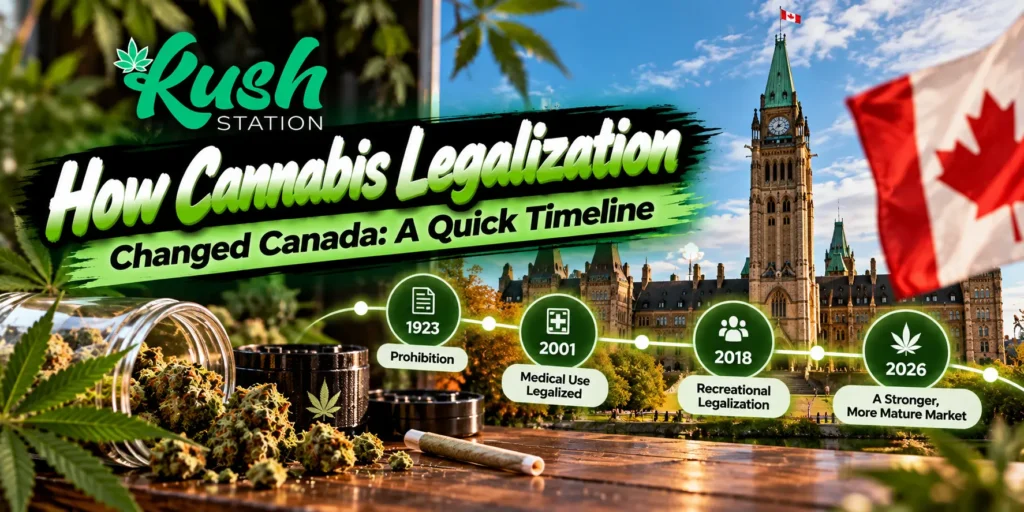
How Cannabis Legalization Changed Canada: A Quick Timeline
Oct
On October 17, 2018, Canada did something that only one country had done before it: it made recreational Sativa vs Indica cannabis legal nationwide. Lines formed outside the first shops in Newfoundland and Labrador as the clock struck midnight, news crews broadcast from across the country, and a century of prohibition officially ended.
It can feel like legalization happened overnight, but it was the result of decades of court cases, government reports, patient advocacy and political debate. And in the years since, the rules, the market and the culture around cannabis have kept changing.
This guide walks through the key moments in Canada’s cannabis story, from the original 1923 ban to the Cannabis Act and what has happened since. We also look at what legalization changed, what it did not, and what it means for people who buy cannabis online today.
Canadian Cannabis Legalization at a Glance
Here is the short version before we dive into the details.
| Year | Milestone |
| 1923 | Cannabis is added to Canada’s list of prohibited drugs |
| 1969 to 1972 | The Le Dain Commission studies non-medical drug use |
| 1996 | The Controlled Drugs and Substances Act replaces earlier drug laws |
| 2000 | Ontario’s Court of Appeal rules in favour of medical access (the Parker decision) |
| 2001 | Canada creates one of the world’s first national medical cannabis programs |
| 2002 | A Senate committee recommends legalization |
| 2014 | Licensed commercial producers begin supplying medical patients |
| 2015 | Federal election campaign includes a promise to legalize |
| 2016 | A federal task force recommends a legal framework |
| 2017 | The Cannabis Act (Bill C-45) is introduced |
| June 2018 | The Cannabis Act receives Royal Assent |
| Oct 17, 2018 | Recreational cannabis becomes legal |
| 2019 | Private shops open in Ontario, record suspensions become easier, and edibles and extracts are legalized |
| 2020 | Cannabis retail is treated as an essential service in several provinces during the pandemic |
| 2022 onward | A legislative review of the Cannabis Act begins |
The sections below fill in the story behind each step.
Before Prohibition: Cannabis in Early Canada
Cannabis has been part of Canadian life for far longer than most people realize. Hemp, the non-intoxicating variety of the plant, was grown in New France in the 1600s for rope, sailcloth and textiles, and colonial authorities actively encouraged farmers to plant it.
In the nineteenth century, cannabis extracts were sold as medicines. Tinctures appeared in pharmacies and doctor’s bags across North America and were used for pain, sleep and a long list of other complaints. There was no widespread public alarm, and no one thought of cannabis as a major social problem.
That was about to change.
1923: Canada Bans Cannabis
In 1923, cannabis was added to the schedule of prohibited drugs under Canada’s Opium and Narcotic Drug Act. Historians note that the change passed with almost no public debate and very little evidence to support it, and that most Canadians at the time had never heard of the plant being used recreationally.
The ban was part of a wider wave of drug prohibition across the Western world, and it coincided with international drug control efforts that continued through the century. Growing, selling and possessing cannabis became criminal offences.
For decades afterward, cannabis remained largely out of the public eye. That began to shift in the 1960s.
The 1960s and 1970s: Counterculture and the Le Dain Commission
By the late 1960s, cannabis use was rising quickly among young Canadians. University students, musicians and the broader counterculture adopted it, and arrests for possession climbed. Many families suddenly had a son or daughter with a criminal record for something that felt harmless to their generation.
In 1969, the federal government created the Commission of Inquiry into the Non-Medical Use of Drugs, widely known as the Le Dain Commission after its chair, Gerald Le Dain. It studied drug use for several years and published its final report in 1972.
The findings were striking. A minority of commissioners recommended the outright legalization of cannabis, and the broader report questioned whether criminal penalties were an effective or proportionate response to simple possession. The government did not act on the recommendations at the time, but the report planted an idea that would resurface for fifty years.
The 1980s and 1990s: Tough Laws and Growing Doubts
The following decades brought a more cautious mood. Drug enforcement was a priority across North America, and cannabis offences continued to result in criminal charges.
In 1996, Canada passed the Controlled Drugs and Substances Act (CDSA), which replaced the earlier Narcotic Control Act and became the country’s main drug law. Cannabis stayed prohibited under the CDSA, though penalties for small amounts of possession were generally less severe than for harder drugs.
Behind the scenes, pressure was building from two directions. Patients with serious illnesses began asking for legal access to cannabis for medical reasons, and a growing number of lawyers, Thc concentrates doctors and public health experts questioned whether criminalization was working. Surveys of the time showed that millions of Canadians had tried cannabis despite the ban.
2000 to 2003: The Courts and the Senate Open the Door
The turn of the century produced the first real cracks in prohibition.
The Parker decision (2000). Terrance Parker, an Ontario man with severe epilepsy, used cannabis to control his seizures and was prosecuted for growing it. In 2000, the Ontario Court of Appeal ruled that the law violated his constitutional rights because it offered no legal way for patients with a medical need to obtain cannabis. The court gave the government time to create a system.
Medical access (2001). The government responded with the Marihuana Medical Access Regulations, which took effect in 2001. Canada became one of the first countries in the world to create a national framework for medical cannabis. The system was limited and often frustrating for patients, who faced paperwork and a narrow supply, but it established the principle that cannabis could be a legal medical option.
A Senate committee speaks (2002). In 2002, a special committee of the Senate, chaired by Senator Pierre Claude Nolin, released a major report after a lengthy study. It recommended that Canada legalize and regulate cannabis, calling prohibition ineffective. A House of Commons committee took a more modest position that same year, recommending decriminalization.
A bill that did not pass (2003). The federal government introduced legislation to reduce penalties for small amounts of cannabis. It died when Parliament was dissolved. That same year, the Supreme Court of Canada ruled in several cases that Parliament had the power to criminalize cannabis, but it also made clear that elected lawmakers were free to change the law if they chose.
The message from this period was important. The courts said legalization was a political decision, and a growing number of experts said it was a sensible one.
2004 to 2014: A Decade of Stalemate and Reform on the Medical Side
For roughly a decade, recreational cannabis policy barely moved. Governments came and went, and the debate continued without a federal decision.
In 2012, the federal government passed a major crime bill that introduced mandatory minimum sentences for some cannabis offences, such as growing larger numbers of plants. That moved in the opposite direction from the earlier reform proposals.
Meanwhile, the medical system was evolving. In 2014, Health Canada replaced the earlier medical rules with the Marihuana for Medical Purposes Regulations, which ended most personal and designated production and created a commercial industry of licensed producers. Companies such as Tweed and others began growing and selling cannabis to registered patients under government licences. That change laid the foundation for the commercial supply chain that would later serve the recreational market.
Court cases continued to push medical access forward. A 2015 Supreme Court decision held that patients could not be restricted to dried cannabis alone, which opened the door for oils and other forms. In 2016, the Federal Court struck down the restrictions on patients growing their own supply, which led to new regulations.
2015 and 2016: A Political Promise and a Task Force
In the 2015 federal election campaign, the Liberal Party, led by Justin Trudeau, promised to legalize, regulate and restrict access to cannabis. The party won a majority government in October of that year.
The new government moved to fulfil its promise through consultation. In 2016, it created the Task Force on Cannabis Legalization and Regulation, chaired by Anne McLellan, a former federal justice minister, and supported by experts in public health, policing, addiction and law. After consultations with thousands of Canadians, provinces, territories, Indigenous groups and international experts, the task force delivered its final report in December 2016.
Its recommendations shaped the law that followed, and included:
A national minimum age of 18, with provinces free to set a higher age
A possession limit of 30 grams of dried cannabis for adults
Permission to grow a small number of plants at home
Strict rules on advertising, branding and packaging
A mix of public and private distribution models, set by the provinces
New measures to deter impaired driving
2017: Bills C-45 and C-46
In April 2017, the government introduced two pieces of legislation that together formed the backbone of legalization.
Bill C-45, the Cannabis Act, created the legal framework for producing, selling, possessing and using cannabis. Its stated purposes were to protect young people from cannabis, keep profits out of the hands of criminals, and protect public health by allowing adults access to a regulated, quality-controlled product.
Bill C-46 dealt with impaired driving. It created new offences for drug-impaired driving, including legal limits for THC in the blood, and gave police the authority to use roadside saliva screening devices and to demand breath samples from drivers.
The House of Commons passed the Cannabis Act in November 2017, and it moved to the Senate, where it received its most thorough debate.
2018: The Year Everything Changed
The Senate studied the bill carefully through the spring. Some senators proposed amendments, including changes related to home cultivation and advertising, and the House of Commons accepted some and rejected others. On June 7, 2018, the Senate voted to pass the bill. The Cannabis Act received Royal Assent on June 21, 2018, and the government set October 17, 2018 as the day it would come into force.
That date made Canada the second country in the world to legalize recreational cannabis nationally, after Uruguay in 2013, and the first member of the G7 to do so.
On legalization day, shops in Newfoundland and Labrador opened first because of the time zone, drawing crowds and enormous media attention. Across the country, provinces rolled out very different retail models.
How provinces approached retail
| Approach | How It Worked | Examples |
| Government-run retail | Provincial agency runs the stores and online sales | Quebec’s SQDC, plus government-operated online sales in several provinces |
| Private retail with government wholesale | Private shops buy from a provincial distributor | Ontario (from 2019), Alberta, Saskatchewan, Manitoba |
| Mixed model | Both public and private stores | British Columbia |
| Online-only at the start | Government website was the only legal option for a time | Ontario in late 2018 |
The early months were rough in some places. Many provinces faced product shortages in the first year, because licensed producers could not grow and supply enough to meet demand. Ontario had no physical stores at launch, which meant the government’s website was the only legal retail option for the first months. Alberta, with private retail, saw a quick burst of new shops. Some people waited in lines for hours, and many stores sold out of popular items within days.
Still, the core system worked. Adults could legally buy cannabis from licensed sellers, and the law was now national.
2019: Edibles, Extracts and Pardons
Legalization in 2018 covered dried flower, oils and seeds, but not edibles, vapes or concentrates. The government said it would legalize those products a year later, after developing additional rules.
Private stores open in Ontario (April 2019). After the initial online-only period, Ontario began allowing private retail shops. Stores were originally allocated through a lottery process, and the number of locations grew rapidly in the following years.
Record suspensions (June 2019). Parliament passed Bill C-93, which created a streamlined process for people with criminal records for simple possession of cannabis to apply for a record suspension (a pardon). The government waived the usual application fee and waiting period. For many Canadians, this was one of the most meaningful parts of legalization, since a record can affect jobs, travel, housing and volunteering.
Cannabis 2.0 (October 17, 2019). On the first anniversary of legalization, new regulations came into force that allowed the legal sale of edible cannabis, cannabis extracts and cannabis topicals. The rules set strict limits, including a maximum of 10 milligrams of THC per package for edibles. Because producers needed time to develop and test these products, they began appearing on store shelves in December 2019 and expanded significantly over the following year.
The arrival of edibles, vapes and concentrates changed the legal market significantly. They are among the categories customers ask about most today. For help getting started, see our guides to THC edibles and types of weed concentrates.
2020: Pandemic Shopping and a Maturing Market
The COVID-19 pandemic reshaped how Canadians bought nearly everything, and cannabis was no exception.
Several provinces classified cannabis retail as an essential service, which kept stores open while many other businesses closed. Rules were loosened to allow curbside pickup and delivery in places that had not previously permitted them, and online ordering surged. Many people who had never bought cannabis online tried it for the first time.
Other notable developments in 2020 included:
Quebec raised its minimum age to 21 at the start of the year, joining the handful of places that set an age above the federal minimum.
The legal market gained ground. Statistics Canada data over this period showed legal sources taking a growing share of overall cannabis spending, helped by more stores, lower prices and a wider range of products.
Edibles and vapes moved from novelty to normal. Beverages, chocolates, gummies and cartridges quickly became mainstream.
2021 to 2023: Consolidation, Competition and Review
The cannabis industry went through a boom and a correction after legalization. Investors poured billions into licensed producers in 2018 and early 2019, and company valuations soared. Then reality set in. Supply outpaced demand, prices fell, and several large companies reported heavy losses.
The result was a wave of consolidation. Large producers merged, smaller ones closed, and the market shifted toward a smaller number of stronger brands alongside a growing craft segment. For consumers, the effect was more competition and lower prices across many product categories.
Policy also kept evolving:
Home cultivation disputes. The Cannabis Act allows up to four plants per household, but Quebec and Manitoba chose to prohibit home growing, which led to legal challenges.
Legislative review. The Cannabis Act required a review of its operation within three years of coming into force. Health Canada began the process in 2022, appointing an expert panel and consulting with the public, provinces, territories, Indigenous groups and industry.
Ongoing conversations about regulation. Topics included packaging and advertising rules, potency limits for edibles, access for medical patients, the role of small and craft producers, and the impact of taxes on the legal market’s ability to compete.
2024 to Today: A Market That Keeps Evolving
In recent years, Canada’s cannabis market has settled into a more stable pattern, though debates continue. The review process produced recommendations, and governments and industry groups have continued to discuss which of them to adopt. Possible areas of change include rules for cannabis sold through delivery, how products can be marketed, and the balance between public health protections and a competitive legal market.
Because laws and regulations change, it is worth checking the latest information from Health Canada and your provincial government. [Update this section with any recent changes before publishing.]
What Legalization Changed
Looking back, here are the biggest shifts.
| Area | Before Legalization | After Legalization |
| Buying cannabis | From the illegal market, with no quality control | From licensed retailers, with testing and labelling |
| Product information | Little or none | THC and CBD percentages, ingredients and warnings |
| Selection | Limited and unpredictable | Flower, pre-rolls, edibles, vapes, concentrates, topicals and more |
| Criminal penalties for adult possession | Possible arrest and a criminal record | Legal within the limits set by law |
| Medical access | Complicated and narrow | Continues alongside the recreational market |
| Shopping options | In person with a dealer | Local stores, delivery and online ordering |
| Packaging | Unregulated | Child-resistant, plain and labelled |
| Public conversation | Mostly whispered | Open, researched and regulated |
A few of these changes deserve a closer look.
Quality and safety. Licensed producers must follow standards for testing and labelling. That means you can see what is in a product and know that it has been checked for things like contaminants and potency. It is one of the strongest arguments for buying from licensed sellers.
Criminal records. Before legalization, many Canadians were charged with simple possession each year. Legalization reduced those charges dramatically, and record suspension measures offered relief to people with past convictions.
Tax revenue and jobs. The legal industry created thousands of jobs in growing, processing, retail, packaging, testing and logistics. Federal and provincial governments also collect tax revenue on sales, with the money shared between levels of government under agreements set up at the start.
Public health data. Legalization made it easier to study cannabis use. Statistics Canada and Health Canada track use patterns through regular surveys, and the numbers help guide policy. Surveys show that use among adults rose modestly after legalization, and that fears of a sudden surge among teenagers did not materialize in the way some had predicted, though protecting young people remains a top priority and continues to be monitored.
Impaired driving laws. Alongside legalization, Canada introduced stricter drug-impaired driving rules, including blood THC limits and roadside testing. Driving after using cannabis remains illegal and dangerous.
What Legalization Did Not Change
Legal does not mean unregulated, and some things are the same as before.
The age limit. You still have to be of legal age: 19 in most provinces and territories, 18 in Alberta and 21 in Quebec.
Possession limits. Adults can carry up to 30 grams of dried cannabis (or its equivalent) in public.
Crossing the border. Taking cannabis across the Canadian border remains illegal, in either direction, and that includes travelling to places where it is legal.
Where you can use it. Rules vary by province. Many restrict use in public places, and landlords, employers and condo boards can set their own policies.
Impaired driving. Penalties are serious, and the new rules make enforcement easier.
The illegal market. It has shrunk but has not disappeared. Buying from licensed sellers keeps your money in the regulated system and gives you a product that has been tested.
Where Canada Fits in the World
Canada’s decision attracted international attention. Uruguay legalized cannabis in 2013, and several American states had legalized it earlier at the state level, but Canada was the first major industrialized country to do so nationally.
Since then, other countries have taken their own steps, from full legalization to decriminalization and medical-only programs. Each country has chosen different rules, which makes Canada’s experience a closely watched example. Researchers, governments and businesses around the world study its results, from public health data to retail models and tax structures.
What This Means If You Buy Cannabis Online Today
For shoppers, the biggest result of legalization is simple: you now have options, information and legal protection that did not exist a decade ago.
You can browse openly. Online menus list strain names, THC and CBD levels, flavour notes and prices.
You can compare. Online dispensaries often carry far more products than local stores, from flower and pre-rolls to edibles, hash and concentrates.
You can shop on your schedule. Ordering online and having cannabis delivered fits into busy lives, and it is often the best choice for people who live far from a store.
You should still be careful. Not every website that sells cannabis follows the rules. Look for age verification, secure checkout, clear policies and honest product information. Our guide to how to buy weed online in Canada covers what to look for.
Kush Station is committed to operating responsibly and serving only customers of legal age. [Add your licensing and compliance details here so readers can see exactly how you operate.]
Frequently Asked Questions
When did cannabis become legal in Canada?
Recreational cannabis became legal across Canada on October 17, 2018, when the Cannabis Act came into force. Medical cannabis had been legally available since 2001.
Was Canada the first country to legalize cannabis?
No. Uruguay legalized it nationally in 2013. Canada was the second country and the first G7 country to do so.
Why was cannabis banned in Canada?
Cannabis was added to the list of prohibited drugs in 1923. Historians note that the decision came with little public debate or scientific evidence, and it followed international trends in drug control at the time.
What is the Cannabis Act?
The Cannabis Act is the federal law that regulates the production, distribution, sale and possession of cannabis in Canada. It sets national rules, such as the possession limit and packaging requirements, while provinces and territories manage retail and local rules.
Are edibles legal in Canada?
Yes. Edibles, extracts and topicals became legal on October 17, 2019, and reached shelves in December 2019. Edibles are limited to 10 mg of THC per package.
What is the legal age to buy cannabis in Canada?
It is 19 in most provinces and territories, 18 in Alberta and 21 in Quebec.
What happened to people with past cannabis convictions?
In 2019, Parliament passed a law allowing people with convictions for simple possession to apply for a record suspension without paying a fee or waiting the usual period.
Can I grow cannabis at home in Canada?
The federal law allows up to four plants per household, but provinces can set their own rules. Quebec and Manitoba do not allow home growing. Check your local laws first.
Is the law still changing?
Yes. The Cannabis Act is subject to ongoing review, and governments continue to consider changes. Check Health Canada and your provincial government for the most current rules.
Final Thoughts: From Prohibition to a Regulated Market
Canada’s cannabis story spans a century, from a quiet ban in 1923 to a national legal market in 2018 and a continuing conversation about how to get the details right. Along the way, patients, lawyers, judges, researchers, politicians and everyday Canadians all helped shape the outcome.