
Blog 2026
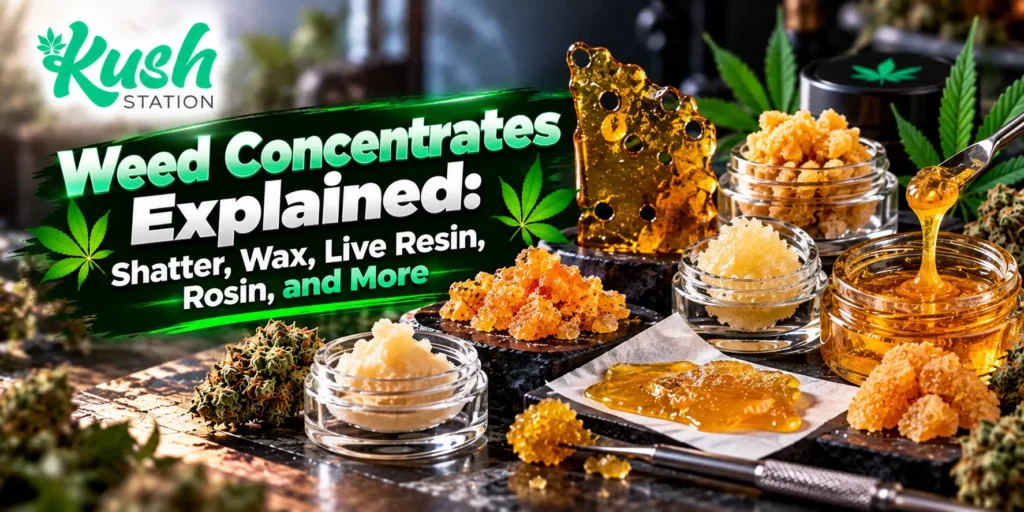
Weed Concentrates Explained: Shatter, Wax, Live Resin, Rosin, and More
Oct
Open the concentrates section of almost any online cannabis menu and you will find a wall of unfamiliar words: shatter, budder, crumble, sauce, diamonds, rosin, distillate. Prices are different, textures are different, and the THC numbers are far higher than anything in the flower category. If you are not sure what you are looking at, it is easy to feel lost, or worse, to buy something much stronger than you intended.
This guide explains weed concentrates in plain language. We cover what they are, how the main types differ, how they are made at a high level, how to read the label, how people use them, and how to stay Cannabis near me safe. We also cover the Canadian rules, so you know what is legal and what to look for when you buy.
Concentrates are not for everyone, and they are not the place to start if you have never used cannabis. But if you are curious, experienced, or simply want to understand what is on the menu, this is your roadmap.
What Are Cannabis Concentrates?
A cannabis concentrate is a product made by separating the most desirable parts of the plant, mainly the cannabinoids (like THC and CBD) and the terpenes (the aromatic compounds), from the leafy plant material. What remains is a dense, sticky, or oily substance with a far higher percentage of active compounds than dried flower.
Dried flower typically tests somewhere around 15% to 30% THC. Concentrates commonly test between 60% and 90% or more. That jump in potency is the single most important thing to understand about them. A small amount goes a long way, and amounts that feel tiny can produce effects much stronger than a joint.
The word “concentrate” is an umbrella term. Shatter, wax, live resin, rosin, hash, and distillate are all concentrates. They differ in how they are made, what they look like, how they taste, and how they feel.
Why Do People Choose Concentrates?
There are a few reasons concentrates have become a major category.
Potency
Concentrates deliver a lot of THC in a small amount of product. For experienced consumers with a high tolerance, they can be more efficient than flower.
Flavour
Many concentrates, particularly live resin and rosin, are made to preserve the plant’s terpenes. The result Indica can be a more intense, vivid flavour than you get from dried flower. For some people, flavour is the entire appeal.
Less plant material
Concentrates contain little or none of the leafy matter found in flower. Some people prefer that, though it is important to note that inhaling any substance carries risks (more on that below).
Versatility
Concentrates can be vaporized, added to flower, or used in various equipment. Some forms are also used as ingredients in other products, like edibles and vape cartridges.
Medical and wellness interest
Some people turn to concentrates because they want a concentrated dose of a particular cannabinoid. If you are considering cannabis for a medical reason, talk to a doctor or pharmacist first, since cannabis can interact with some medications and is not appropriate for everyone.
Concentrates vs. Flower: Quick Comparison
| Feature | Dried Flower | Concentrates |
| Typical THC | 15% to 30% | 60% to 90%+ |
| Amount used per session | Grams or fractions of a gram | Tiny amounts, often a fraction of a pinhead to a rice grain |
| Onset | Within minutes | Within minutes (often faster and stronger) |
| Flavour | Varies by strain and cure | Can be very intense, especially live products |
| Equipment | Papers, pipe, grinder, vaporizer | Often specialized equipment |
| Best for | Beginners and everyday use | Experienced consumers |
| Cost per gram | Lower | Higher, but a gram lasts longer |
Do not compare by gram alone. A gram of concentrate can last far longer than a gram of flower because the dose per session is so much smaller.
Are Concentrates Legal in Canada?
Yes. Cannabis extracts for inhalation became legal for adult purchase in Canada in late 2019, when the federal government added “Cannabis 2.0” products (edibles, extracts, and topicals) to the legal market. Like all cannabis in Canada, concentrates must be purchased from provincially authorized retailers, and each province and territory sets its own retail and online rules.
Age limits
The minimum age is 19 in most provinces and territories, 18 in Alberta, and 21 in Quebec. You must confirm your age when you order, and you will be asked for ID on delivery.
Possession limits
Canada uses an equivalency system so that different product types can be compared to dried flower. The federal public possession limit is 30 grams of dried cannabis, and the equivalent for solid concentrates is far smaller: roughly 7.5 grams. That is because one gram of dried cannabis is treated as equal to about 0.25 grams of solid concentrate. Check the current federal and provincial guidance, as rules can change.
Packaging and labelling
Legal concentrates carry the standardized cannabis symbol, a health warning, and clear THC and CBD content. Products are sold in child-resistant packaging. Inhaled extracts may also be subject to limits on what can be added, including restrictions on certain additives and flavours, so legal products tend to be simpler than what you might see on the unregulated market.
Why licensed sellers matter
Because concentrates are processed products, quality control matters even more than it does with flower. Licensed producers must test their products and follow regulated production standards. Unlicensed sources may sell concentrates made with unknown solvents, no lab testing, and no reliable labelling. If a concentrate is made with a solvent and not properly purged, residues can remain in the final product. Buying only from authorized retailers is the best protection.
Laws change, so always check your provincial government’s website for current rules. [Add your licensing and compliance details here.]
How Concentrates Are Made (The Short Version)
You do not need to understand the chemistry to buy concentrates, but a basic idea of how they are made helps explain why products look and taste different.
There are two broad families: solvent-based and solventless.
Solvent-based extraction
These methods use a solvent, such as a hydrocarbon (butane or propane), carbon dioxide (CO2), or ethanol, to Sativa dissolve cannabinoids and terpenes out of the plant. The solvent is then removed through a carefully controlled purging process, leaving the concentrate behind. Shatter, wax, budder, crumble, sauce, and diamonds are generally made this way.
Solvent-based extraction is done in professional, licensed facilities with specialized, closed-loop equipment. It is not something to attempt at home. Several of these solvents are highly flammable, and improvised extraction is a well-known cause of fires and explosions. In Canada, producing extracts using flammable solvents outside of licensed facilities is also illegal and dangerous. Leave it to the professionals.
Solventless extraction
These methods separate the resin glands (trichomes) from the plant using physical means, such as ice water, sieves, heat, and pressure, without chemical solvents. Rosin, bubble hash, dry-sift, and kief fall into this category. Many consumers prefer solventless products because they have no solvent residue concerns, though quality still depends on the starting material and the maker.
Fresh-frozen vs. cured
Another important distinction is what the plant material looked like before extraction. Cured material has been dried and aged like regular flower. Fresh-frozen material is frozen immediately after harvest, which preserves more of the plant’s volatile terpenes. Products made from fresh-frozen material are usually labelled “live” (live resin, live rosin), and they tend to taste and smell more vibrant.
The Main Types of Weed Concentrates
Here is a closer look at each major category you will see on a menu.
Shatter
Shatter is a hard, glass-like, translucent concentrate that is typically amber or golden in colour. It breaks or “shatters” when snapped, which is how it got its name. It is usually made with a hydrocarbon solvent and has a stable, smooth texture.
Shatter is known for its clean look and high potency, often 70% to 90% THC. Because it is solid and non-sticky compared with some other forms, it is relatively easy to handle and portion. Flavour is typically milder than live products, since some terpenes are lost during processing.
Best for: Experienced users who want a high-potency product that is easy to measure.
Wax
“Wax” is a general term for a soft, opaque, crumbly or sticky concentrate, often light yellow or tan. It has a texture similar to candle wax or earwax. It is typically made by whipping or agitating the extract during purging, which creates a cloudy, opaque texture.
Wax usually has good flavour and high potency. It is easy to scoop and portion but can stick to tools and surfaces.
Best for: Experienced users who want an easy-to-portion product.
Budder and badder
Budder (also spelled “badder” or “batter”) is a type of wax with a smooth, creamy, butter-like consistency. It is whipped to create a soft, spreadable texture. It is generally easy to work with and often has a strong flavour.
Best for: People who like a creamy, scoopable texture.
Crumble
Crumble is a dry, brittle concentrate that breaks apart into crumbs. It has a honeycomb-like texture and is typically lighter in colour. It can be less sticky than other waxes and can be crumbled into a joint or bowl.
Best for: Those who want something that is easier to sprinkle than to scoop.
Live resin
Live resin is made from fresh-frozen cannabis rather than dried and cured material, which helps preserve the plant’s original terpenes. The result is a concentrate with a notably rich aroma and flavour. It is often soft and saucy or sugary in texture, and it can vary in colour from pale yellow to amber.
Live resin has become one of the most popular concentrate types, especially among people who care about taste. It is generally more expensive than shatter or wax because the process and starting material are more demanding.
Best for: Flavour-focused consumers.
Sauce and diamonds
Sauce is a terpene-rich, runny concentrate with a texture similar to a thick liquid or wet jam. When THCA crystals form within it, you get “diamonds and sauce”: solid, crystalline structures of nearly pure THCA sitting in a pool of terpene-rich liquid.
The diamonds can be extremely potent, sometimes testing near the high 90s for THCA. This makes diamonds and sauce one of the most powerful forms of concentrate on the market.
Best for: Very experienced consumers only.
Rosin
Rosin is a solventless concentrate made by applying heat and pressure to flower, kief, or hash, squeezing out the resin. It has a sap-like, sticky texture that can range from runny to firm depending on the starting material and temperature.
There are a few common varieties:
Flower rosin: Pressed directly from dried flower.
Hash rosin: Pressed from bubble hash or dry-sift, usually producing a higher yield and sometimes a smoother, more refined product.
Live rosin: Pressed from fresh-frozen material that has first been turned into ice-water hash, preserving more terpenes. It is typically the most premium form.
Because rosin involves no solvents, many consumers see it as a cleaner choice. It tends to be more expensive due to lower yields and labour-intensive production.
Best for: People who prefer solventless products and strong flavour.
Distillate
Distillate is a highly refined, thick, clear oil that is typically very high in THC, often 85% to 95% or more. Through a process of repeated refinement, almost everything except the targeted cannabinoid is removed, including most of the terpenes. That means distillate can be potent but fairly flavourless on its own.
Because it is neutral, distillate is used as a base in many products, including vape cartridges, edibles, and oils. Manufacturers sometimes add back terpenes (often cannabis-derived) to restore flavour.
Best for: Vape cartridge users and anyone who wants high potency with little taste.
Hash
Hash is one of the oldest cannabis concentrates in the world. It is made by collecting and compressing the plant’s resin glands. It comes in several forms:
Kief: The loose, powdery crystals of trichomes that collect in a grinder.
Dry-sift: Resin sifted through fine screens to separate it from plant material.
Bubble hash: Resin separated using ice water and fine mesh bags, resulting in a crumbly, sandy product that ranges from light tan to dark brown.
Pressed or traditional hash: Resin compressed into blocks or balls.
Hash generally sits between flower and the high-potency extracts in strength, though quality varies widely. It can be crumbled into a joint or pipe, or used in a vaporizer designed for concentrates.
Best for: People who enjoy a traditional, earthy flavour and want something less intense than shatter or diamonds.
Cannabis oils and RSO
Oils are liquid extracts, usually taken orally or sublingually (under the tongue). They are measured in milligrams of THC or CBD per millilitre and come in various ratios. RSO, short for “Rick Simpson oil,” is a thick, dark, full-spectrum oil that is typically very high in THC and is usually taken in tiny amounts.
Oils act more like edibles than inhaled concentrates, with slower onset and longer duration. They are often favoured by people who do not want to inhale.
Best for: Smoke-free users who want precise dosing.
Vape cartridges
Vape cartridges are pre-filled with a cannabis oil, commonly distillate or a live-resin-based oil, and attach to a battery. They are probably the most accessible concentrate format because they require no extra tools. You press a button or inhale and take a puff.
Because they are so easy to use, it is also easy to overdo it. Take a puff or two, wait, and see how you feel.
Best for: Portability and convenience.
Concentrate Types at a Glance
| Type | Texture | Typical THC | Flavour | Process | Best For |
| Shatter | Hard, glass-like | 70% to 90% | Mild to moderate | Solvent | Easy portioning |
| Wax | Soft, opaque | 65% to 85% | Moderate to strong | Solvent | Scoopable use |
| Budder/badder | Creamy, smooth | 65% to 85% | Moderate to strong | Solvent | Texture lovers |
| Crumble | Dry, brittle | 65% to 85% | Moderate | Solvent | Sprinkling |
| Live resin | Saucy or sugary | 65% to 85% | Very strong | Solvent, fresh-frozen | Flavour |
| Sauce/diamonds | Liquid with crystals | 70% to 95%+ | Very strong | Solvent | Very experienced users |
| Rosin | Sap-like | 60% to 80% | Strong | Solventless | Clean preference |
| Distillate | Thick, clear oil | 85% to 95% | Mild | Solvent, refined | Vapes and edibles |
| Hash | Crumbly or pressed | 30% to 60% | Earthy | Solventless | Traditional taste |
| Oils/RSO | Liquid | Varies by mg/mL | Varies | Solvent or CO2 | Smoke-free use |
Ranges are general. Always check the product label for exact potency.
How to Read a Concentrate Label
Concentrates have some unique label details worth understanding.
THC and THCA. Raw cannabis contains mostly THCA, which is not intoxicating until it is heated (a process called decarboxylation). Labels may list THCA and THC separately, and some show “total THC,” which accounts for the conversion that happens when heated. Total THC gives a better picture of real-world potency.
CBD. Most concentrates are high in THC, but some contain CBD or a balanced ratio. These can be a gentler option.
Terpene content. Some products list their terpene percentage. Higher terpene content usually means more flavour and aroma.
Product format and extraction method. Look for whether it is live or cured, solvent-based or solventless. Good retailers list this in the description.
Batch and lot number. This allows you to trace the product and is a sign of a regulated item.
Net weight. Concentrates are often sold in 0.5 g, 1 g, or 2 g units, but sizes vary.
| Label Term | What It Means | Why It Matters |
| THCA % | Raw acidic form of THC | Converts to THC when heated |
| Total THC | Estimated THC after heating | Best indicator of real potency |
| CBD % | Non-intoxicating cannabinoid | Can soften THC’s effects |
| Terpenes % | Aroma and flavour compounds | More terpenes often means more flavour |
| Live / cured | Fresh-frozen vs. dried starting material | Affects taste and aroma |
| Solventless | Made without chemical solvents | Preference for some buyers |
How Do People Use Concentrates?
Concentrates are not used like a regular joint. Because they are sticky, oily, or crystalline, they generally need equipment designed for them. Here are the common methods.
Dabbing
“Dabbing” means vaporizing a small amount of concentrate on a heated surface and inhaling the vapour. It typically uses a specialized rig with a heating element, which may be a torch-heated surface or an electronic device. Dabbing delivers a very strong dose very quickly, which is why it is not recommended for beginners.
Torches and open flames carry a burn risk, and heating surfaces get extremely hot. Anyone considering dabbing should learn the equipment properly, and many people find electronic devices easier and safer than torches.
Concentrate vaporizers and vape pens
Portable vaporizers designed for concentrates heat the product at a controlled temperature without combustion. They are easier to use than traditional rigs and give you more control over temperature. Lower temperatures generally preserve flavour and are smoother, while higher temperatures produce larger clouds and a stronger effect.
Cartridge vapes
These are pre-filled and require only a compatible battery. They are the simplest option and the most beginner-friendly in terms of equipment, though the oil inside is still very potent.
Adding to flower
Some people crumble a small amount of hash or crumble into a joint or bowl to boost the strength of flower. This should be done carefully, since the potency can increase significantly.
Oral use
Oils and some concentrates are taken orally or used in cooking. Oral products take longer to work and last longer. As with edibles, wait at least two hours before taking more.
Equipment checklist
| Method | What You Need | Skill Level |
| Cartridge vape | Battery and pre-filled cartridge | Beginner |
| Concentrate vape pen | Compatible device | Beginner to intermediate |
| Dabbing | Rig, heating method, dab tool | Intermediate to advanced |
| Adding to flower | Flower and a small amount of concentrate | Intermediate |
| Oral oils | Syringe or dropper | Beginner (go slow) |
Dosing and Safety: Start Low and Go Slow
If there is one section to read carefully, this is it.
Start much smaller than you think
The most common mistake with concentrates is taking too much. A dose that seems tiny, such as a small crumb or a drop the size of a pinhead, can be plenty for someone with low tolerance. Experienced users take their time and increase gradually. If you are new to concentrates, think smaller than your instincts tell you.
Wait between doses
Inhaled concentrates take effect quickly, usually within minutes, but peak effects can take a little longer. Wait at least 15 to 30 minutes before taking more. For oral products, wait at least two hours.
Know your tolerance
Your experience with flower does not translate directly to concentrates. Someone who is comfortable with a few puffs of flower may find a single dab overwhelming.
Possible side effects
High-potency cannabis can cause:
Anxiety, paranoia, or panic
A racing heart
Dizziness or fainting
Dry mouth and red eyes
Nausea
Impaired memory and coordination
Coughing or throat irritation from inhalation
Most of these pass, but they can be frightening, especially for new users.
Long-term considerations
Regular use of high-potency products is associated with a higher risk of developing cannabis use disorder and, in some people, with mental health concerns including anxiety, depression, and psychosis, particularly for people with a personal or family history of mental illness. Frequent heavy use has also been linked to cannabis hyperemesis syndrome, a condition causing repeated vomiting. Health Canada’s guidance on lower-risk cannabis use suggests choosing lower-THC products, avoiding daily use, and avoiding inhaling deeply or holding your breath. If you are concerned about your use, talk to a healthcare professional.
Who should avoid concentrates
Cannabis is not appropriate for everyone. Avoid concentrates if you are pregnant or breastfeeding, under the legal age, have a history of psychosis or serious mental health conditions, or are taking medications that may interact. When in doubt, ask a doctor or pharmacist.
General safety rules
Never drive or operate machinery after using cannabis.
Do not combine with alcohol.
Keep all concentrates locked up and away from children and pets.
Use equipment carefully, especially anything that involves heat or flame.
Do not attempt to make concentrates at home with solvents.
Do not use products that smell like chemicals or look suspicious.
What If You Take Too Much?
If you overdo it, the effects are temporary. Find a quiet, comfortable place, sit or lie down, drink water, and have a light snack. Try to stay calm, and ask a trusted friend to stay with you. Do not drive. If you experience severe symptoms such as chest pain, a heart rate that will not settle, or confusion that does not ease, seek medical help immediately. If a child or pet has ingested any cannabis product, contact poison control or a veterinarian right away.
How to Choose the Right Concentrate for You
The best concentrate depends on your experience, your equipment, and what you want.
If you are brand new to cannabis: Start with flower or low-dose edibles, not concentrates.
If you are experienced with flower and curious: Consider a low-dose cartridge vape or a small amount of hash. These are easier to control than dabs.
If flavour is your priority: Look at live resin, live rosin, or sauce, which retain more terpenes.
If you want a solventless option: Rosin, bubble hash, and dry-sift are your choices.
If you want maximum potency and have a high tolerance: Shatter, wax, and diamonds deliver the highest numbers, but they demand the most respect.
If you want a neutral option for vapes or oral use: Distillate and oils are flexible, though they offer less flavour.
If you do not want to inhale: Oils, tinctures, capsules, and edibles are better fits.
Concentrates vs. Edibles vs. Flower
| Flower | Edibles | Concentrates | |
| Potency | Moderate | Measured in mg | Very high |
| Onset | Minutes | 30 min to 2 hours | Minutes |
| Duration | 1 to 3 hours | 4 to 8+ hours | 1 to 3+ hours |
| Equipment | Simple | None | Often specialized |
| Dose control | Moderate | High (labelled mg) | Requires care |
| Best for | Beginners | Smoke-free users | Experienced users |
Buying Concentrates Online: What to Look For
Ordering concentrates online follows the same steps as ordering any cannabis product, but a few extra checks are worth making.
Confirm the store is authorized. Look for provincial licensing or authorization details, and avoid sites that lack them.
Verify your age. Reputable retailers check your age and ask for ID on delivery.
Read the full product description. Look for the type, extraction method, THC and CBD content, and terpene information.
Check lab results if available. Some retailers link to certificates of analysis, which show potency and contaminant testing.
Compare sizes and prices. A cheap price on a very potent product can be a red flag. Compare per-gram prices across products and retailers.
Check reviews. Look for feedback on flavour, consistency, and packaging.
Read shipping and return policies. Concentrates can be sensitive to heat, so check how the retailer handles shipping, especially in summer.
Start with a small size. Try a half-gram before committing to larger amounts.
| What to Check | What a Good Store Does | Red Flag |
| Licensing | Shows provincial authorization | No licence information |
| Age verification | Verifies your age | No age check |
| Product details | Lists type, THC, terpenes, and process | Vague or missing details |
| Lab information | Shares testing results | No testing mentioned |
| Pricing | Clear and consistent | Prices far below the market |
| Packaging | Child-resistant, labelled, discreet | Unlabelled or poorly sealed |
| Support | Responsive contact options | No contact details |
[Add what makes your store different: selection size, sourcing, lab testing practices, customer service, loyalty rewards, and so on.]
Storing Your Concentrates
Concentrates are sensitive to heat, light, and air, so good storage helps preserve their texture, flavour, and potency.
Keep them cool. Heat can soften shatter, make wax runny, and degrade terpenes. A cool, dark place works for most products.
Use airtight containers. Glass or silicone containers with tight lids help protect against air and moisture.
Consider the fridge for live products. Some people store live resin and rosin in the refrigerator to preserve terpenes, though you should follow the producer’s guidance and allow the product to come back to room temperature before opening.
Avoid sunlight. UV light breaks down cannabinoids and terpenes.
Store cartridges upright and away from extreme temperatures.
Lock everything up. Keep all cannabis products out of reach of children and pets. Highly potent products can be especially dangerous if swallowed accidentally.
Common Myths About Concentrates
“Higher THC always means a better experience.” Not necessarily. Flavour, terpenes, tolerance, and context all matter. Many experienced consumers prefer a moderate potency product with a great terpene profile.
“Solventless is always better.” Solventless products appeal to many people, but quality depends on the grower, the maker, and the testing. A well-made, lab-tested solvent-based product can be excellent.
“Concentrates are the same as flower, just stronger.” The experience can differ significantly in intensity and onset. Treat them as a different product.
“Distillate is lower quality.” Distillate is simply a different style. It is potent and clean but low in flavour, which suits some uses very well.
“A little more will not hurt.” With concentrates, a little more can be a lot more. Patience is your best tool.
Frequently Asked Questions
What is the difference between shatter and wax?
Shatter is hard, translucent, and glass-like. Wax is soft, opaque, and crumbly or sticky. Both are typically made with solvents and are high in THC. The difference mostly comes from how the extract is handled during processing.
What is the difference between live resin and rosin?
Live resin is made from fresh-frozen plants using a solvent, while rosin is made without solvents, using heat and pressure. Both can retain strong flavour, particularly in their “live” versions. Rosin is generally more expensive and favoured by people who prefer solventless products.
Are concentrates stronger than flower?
Yes, considerably. Concentrates often test at 60% to 90% THC or more, compared with roughly 15% to 30% for flower.
Are concentrates legal in Canada?
Yes. Inhaled and ingestible extracts have been legal for adult purchase through authorized retailers since late 2019. Age limits and rules vary by province.
What is the best concentrate for beginners?
Concentrates are generally not recommended for people who are new to cannabis. If you are experienced with flower and curious, a low-dose cartridge or a small amount of hash is usually a gentler entry point than dabs.
What is THCA?
THCA is the raw, non-intoxicating form of THC found in the plant. It converts to THC when heated.
How much concentrate should I use?
Start with an extremely small amount, then wait before taking more. The right amount depends on your tolerance, the product, and the method. When in doubt, use less.
Can I make concentrates at home?
No. Many methods use flammable solvents and carry serious fire and explosion risks, and making extracts this way outside licensed facilities is illegal in Canada. Buy products from licensed retailers instead.
How long do concentrates last?
Stored properly in a cool, dark, airtight container, concentrates can stay good for many months. Over time, flavour and potency can fade, and texture can change.
Do concentrates smell?
Some do, especially terpene-rich products like live resin. Vapes and low-temperature methods produce less odour than combustion, but you should still only use cannabis where it is legal.
Will my order be discreet?
Reputable retailers use plain outer packaging. The products inside will carry the legally required labels and child-resistant packaging.
Final Thoughts: Respect the Potency
Concentrates are among the most interesting and most powerful products on the cannabis market. Understanding the differences between shatter, wax, live resin, rosin, hash, and distillate helps you choose a product that matches your taste, your tolerance, and your equipment instead of buying on a THC number alone.
The key takeaways are simple. Concentrates are far stronger than flower. Start with the smallest amount you can, wait before taking more, and buy only from licensed retailers who share clear product information. Learn your equipment, store your products safely, and never drive or mix with alcohol.