
Blog 2026
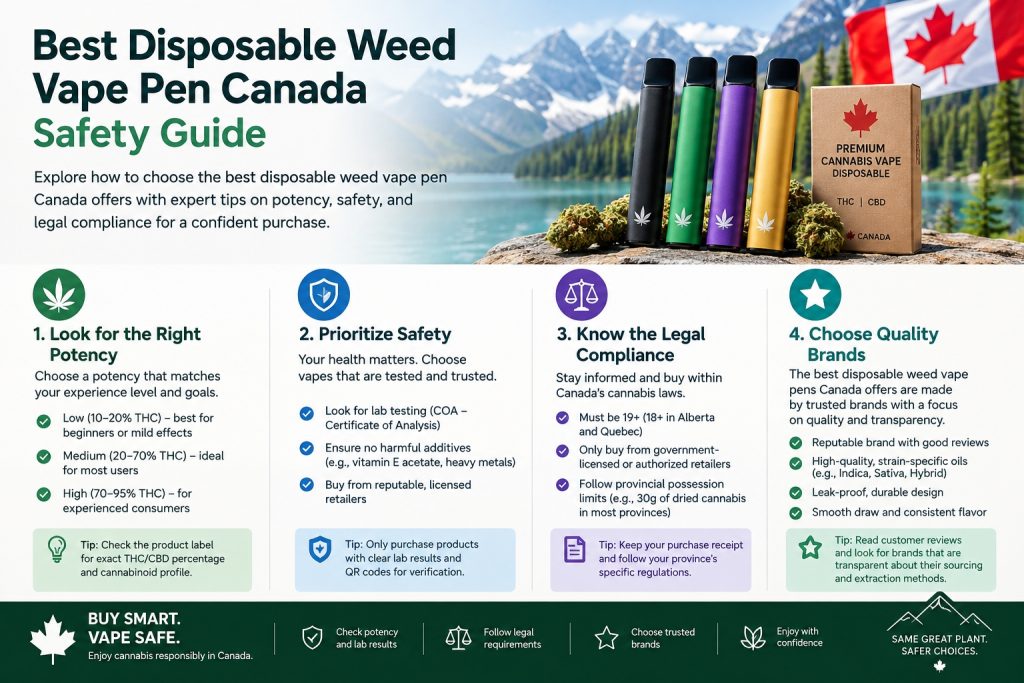
Best Disposable Weed Vape Pen Canada: Safety Guide
Nov
Searching for the best disposable weed vape pen Canada has to offer sounds straightforward, until “best” starts meaning strongest, cheapest, tastiest, safest, or least likely to clog. Those aren’t the same thing.
This review doesn’t crown a specific winner. Canadian inventories change quickly, products vary by province, and popularity isn’t proof of quality or safety. Instead, you’ll get a neutral framework for comparing cannabis all-in-ones by extract, labelling, hardware, traceability, testing, and environmental impact. There are no affiliate links or paid placements here. Kush Station sells vape products; this guide doesn’t rank or recommend any of them.
If you choose to use cannabis, the goal is informed harm reduction, not pretending vaping is harmless. You’ll learn how to read the package, recognize unsupported marketing, check recalls, and spot a device that belongs in hazardous-waste collection rather than your pocket. Think of this as the practical checklist you’d want before standing at a retailer’s counter or scrolling a product page, squinting at five nearly identical boxes.
Key Takeaways
- The best disposable weed vape pen Canada offers should be chosen based on clear labelling, legal traceability, appropriate potency, and safe hardware rather than just THC content or price.
- Avoid relying solely on bestseller lists, brand claims, or user reviews as they don’t guarantee product safety or quality; always check for independent testing and regulatory compliance.
- Understand the differences in cannabis extracts like distillate, live resin, and live rosin, and carefully read cannabinoid content and ingredient labels for informed dosing.
- Always verify legal restrictions, provincial regulations, and recall notices before purchasing, and buy from sellers who show full labels and product information.
- Stop using any vape pen that overheats, leaks, or shows damage and dispose of lithium-ion batteries responsibly according to local hazardous waste guidelines to minimize environmental impact.
What Does “best disposable weed vape pen canada” Actually Mean?
The best disposable weed vape pen Canada shoppers can choose isn’t necessarily the one with the highest THC number. A defensible choice should provide clear ingredients, reliable traceability, suitable potency, functional hardware, and disposal instructions.
Your priorities matter too. Someone seeking CBD-dominant effects has a very different “best” product from an experienced high-THC consumer.
Why Bestseller Lists, Brand Claims and User Reviews Are Not Safety Evidence
Sales rankings mainly reveal what was available, promoted, or inexpensive. Brand phrases such as “premium,” “medical-grade,” and “ultra-pure” may lack standardized definitions. Reviews can identify recurring clogs or leaks, but they can’t detect contaminants or verify laboratory results.
Use reviews as durability clues, not toxicology reports. A five-star comment saying “hit me hard” is especially poor evidence of quality.
Scope: Cannabis All-in-Ones, Not Nicotine Vapes or Dry-Herb Devices
This guide covers prefilled, battery-powered cannabis devices sold as one integrated unit. It doesn’t evaluate nicotine disposables, refillable e-liquids, dab pens, or vaporizers that heat dried flower.
Those categories use different materials, temperatures, regulations, and maintenance routines. Mixing their advice, particularly homemade refill instructions, can create avoidable contamination, leakage, or battery hazards.
Disposable Cannabis Vape Pens: Key Device Differences
Cannabis all-in-ones combine extract, heating element, airflow path, and battery. Differences in oil viscosity, coil design, temperature control, charging electronics, and mouthpiece construction can affect performance.
You usually can’t inspect those parts before purchase, so complete specifications and a traceable supply chain carry more weight than glossy packaging.
Disposable All-in-Ones vs. Cartridges and Reusable Batteries
A 510-thread cartridge separates the oil container from a reusable battery. That lets you replace only the cartridge, adjust voltage on some batteries, and reduce repeated battery disposal.
An all-in-one is simpler: open the package and inhale, subject to its activation design. But if its coil, airflow sensor, or battery fails, the remaining extract may become unusable.
Rechargeable Does Not Necessarily Mean Refillable
A USB-C port often exists so the battery can finish vaporizing the factory-filled oil. It doesn’t automatically make the reservoir refillable.
Don’t pry open, puncture, or inject oil into a sealed device. Besides causing leaks, improvised refilling can damage the cell or introduce incompatible liquids. Follow the producer’s directions, and charge only while the device is visible on a nonflammable surface.
Understanding Cannabis Extracts and Label Claims
Extract terminology describes processing and inputs, not guaranteed effects or craftsmanship. Two products labelled “live resin” may differ substantially in cultivar, cannabinoid profile, additives, storage history, and hardware.
Read the regulated label first. The front-panel design and strain name are marketing layers: the ingredient list and cannabinoid values tell you more.
Distillate, Live Resin and Live Rosin: What the Terms Describe
Distillate is highly refined and commonly THC-forward: terpenes may be added afterward. Live resin generally uses fresh-frozen cannabis and solvent-based extraction to retain volatile compounds. Live rosin is made without hydrocarbon solvents, typically using heat and pressure after ice-water separation.
“Solventless” doesn’t mean risk-free, while “full-spectrum” has no single consumer guarantee of better effects.
THC, CBD and Total Cannabinoid Content: Reading the Label
Canadian labels may show THC and CBD as quantities “per activation,” “per unit,” or by concentration, depending on the product format and applicable rules. Confirm whether a figure is in milligrams per gram, milligrams per unit, or a percentage: they aren’t interchangeable.
For a newer consumer, modest THC and measurable CBD may be easier to manage than chasing the largest number. Start with one small inhalation and wait before taking another.
Terpenes, Flavourings and the Limits of Indica–Sativa Predictions
Terpenes contribute aroma, citrus-like limonene or pine-like alpha-pinene, for example, but a terpene list can’t reliably predict your individual experience. Likewise, “indica,” “sativa,” and dessert-style names aren’t precise pharmacological categories.
Check whether flavouring agents or botanical terpenes appear in the ingredients. Your response also depends on dose, tolerance, mood, setting, and recent cannabis use.
A Neutral Comparison Framework for Disposable Cannabis Vapes
Compare candidates using the same questions rather than choosing whichever box shouts loudest. A good retailer should be able to show package information before purchase, although return policies for opened cannabis products are understandably limited.
Prioritize traceability and a potency you can comfortably dose. Flavour and price belong farther down the checklist.
Comparison Table: Label Transparency, Extract Type, Hardware and Waste
| Factor | Stronger evidence | Warning sign |
|---|---|---|
| Label | Complete ingredients, lot and producer | Vague or missing details |
| Extract | Processing method clearly identified | Undefined “premium oil” |
| Hardware | Capacity, charging and storage guidance | Huge puff claim, few specifications |
| Traceability | Named producer, lot number and intact package | Anonymous seller or altered package |
| Waste | Manufacturer or local return route | “Throw anywhere” messaging |
No row proves safety alone. Together, though, they expose weak claims surprisingly quickly.
Why Oil Capacity and Advertised Puff Counts Can Be Misleading
A larger reservoir offers more oil, not automatically better value. Thick extract may clog, flavour can deteriorate, and an undersized battery may struggle before the oil is finished.
Puff counts depend on inhalation length, temperature, airflow, and testing method. One person’s quick sip is another person’s fog-machine audition. Compare net quantity and cannabinoid concentration instead of treating puff estimates as precise.
Evidence Standards: Verified Specifications vs. Independent Testing
Separate three evidence levels:
- Required package information, including producer and lot identifiers.
- Manufacturer specifications, such as coil material or charging design.
- Independent evidence, such as accredited testing or documented investigations.
A manufacturer’s certificate may be useful, but it isn’t independent simply because it contains numbers. Ask who sampled the product, which lot was analyzed, what methods were used, and whether results are publicly verifiable.
Canadian Cannabis Regulations and Provincial Differences
Canada regulates legal cannabis federally, while provinces and territories control areas such as distribution, retail access, age rules, and where use is permitted. Product availability can hence change when you cross a provincial boundary, even if you remain within Canada.
Check your provincial cannabis regulator and retailer before buying: old roundup articles age faster than an opened vape.
Minimum Legal Ages and Provincial Restrictions on Cannabis Vapes
The minimum age is 18 in Alberta, 21 in Quebec, and 19 in all other provinces and territories. Local possession and consumption restrictions can be stricter.
Quebec kept cannabis vaping products out of its legal retail system for years, but the SQDC began selling vape cartridges and batteries on November 26, 2025, and other jurisdictions may impose product or sales limitations. Confirm current rules through official provincial sources, especially when traveling or ordering online. Legal age doesn’t mean cannabis is low-risk for young adults.
Required Packaging, THC Limits and Excise Stamps Where Applicable
Legal products generally require plain, child-resistant packaging, standardized cannabis symbols where triggered, health warnings, cannabinoid information, ingredients, producer details, and lot identifiers. An excise stamp should correspond to the province or territory of sale, subject to applicable exceptions.
The federal 10 mg THC limit applies to each package of edible cannabis, not universally to vape containers. Cannabis extracts, including vapes, are capped at 1,000 mg THC per container. Don’t transfer edible-dose assumptions to inhaled extracts.
Why U.S. THCA Rankings May Not Apply to Canadian Products
U.S. “hemp-derived THCA” lists reflect different federal and state rules, testing systems, marketplaces, and product definitions. They don’t establish legality or availability in Canada.
Importing a highly ranked American vape can still violate Canadian border law. It may also bypass Canada’s legal production, packaging, excise, and recall framework. For Canadian shopping decisions, use Canadian regulatory information, not a U.S. affiliate leaderboard.
Product Testing, Traceability and Recall Checks
Legal-market traceability gives regulators a route from a packaged unit back to its production lot. That’s an important advantage over unregulated products, but it doesn’t make every device flawless.
Keep the package and receipt until the device is finished. That boring little box becomes extremely useful when a defect or recall appears.
What Regulatory Testing Can, and Cannot, Establish
Licensed producers must meet federal requirements covering matters such as contaminant limits, composition, and quality-control systems. Testing can assess defined analytes in a submitted sample under specific methods.
It cannot guarantee zero risk, predict your reaction, or prove every device will heat identically. Sampling limitations, evolving evidence about inhaled additives, and hardware variability remain meaningful knowledge gaps.
Lot Numbers, Packaging Dates and Health Canada Recall Notices
Before use, photograph the lot number, package date, producer, and product name. If something seems wrong, compare those details with Health Canada cannabis recalls and safety alerts.
For a suspected defect, stop using the device and contact the retailer or producer. Report adverse reactions through appropriate health channels: seek urgent help for breathing difficulty, chest pain, severe confusion, or loss of consciousness.
Health Risks and Device Safety
Cannabis vapour can expose you to THC, aerosols, irritants, and thermal degradation products. Long-term evidence is still developing, especially for newer formulations and hardware.
Avoid use if you’re pregnant or breastfeeding. If you have cardiovascular, respiratory, or psychiatric concerns, or take interacting medication, speak with a qualified healthcare professional rather than relying on a budtender for medical guidance.
High-THC Exposure, Impairment, Dependence and Respiratory Risks
High-THC extracts can produce anxiety, panic, dizziness, vomiting, impaired judgment, or psychotic symptoms, particularly in susceptible people. Frequent use raises the risk of cannabis use disorder.
Take a small inhalation, wait, and don’t drive or operate machinery while impaired. Avoid mixing cannabis with alcohol or sedating drugs. Vaping avoids smoke from combustion, but avoiding smoke is not the same as avoiding harm.
Leaking, Overheating or Damaged Devices: When to Stop Using Them
Stop immediately if the device becomes unusually hot, swells, hisses, leaks, tastes burnt, activates by itself, or has a damaged charging port. Don’t keep it in your pocket, charge it overnight, or “see if one more pull fixes it.”
Move it away from flammable materials without touching a dangerously hot battery. Follow local fire-service or waste-facility advice for damaged lithium-ion devices.
Keeping Cannabis Away From Children and Pets
Store cannabis locked, elevated, and out of sight, preferably in its original child-resistant package. A colourful disposable can resemble a marker or candy-flavoured gadget, while residual oil may remain after it stops producing vapour.
If a child consumes cannabis, contact your provincial poison centre promptly at 1-844-POISON-X (1-844-764-7669), or 1-800-463-5060 in Quebec, and call 911 in an emergency. For pet exposure, call a veterinarian or emergency animal hospital: don’t induce vomiting unless a professional instructs you.
Environmental Impact and Safe Disposal in Canada
Every all-in-one combines a lithium-ion battery, electronics, plastics or metals, a heating element, and cannabis residue. Calling it “disposable” describes convenience, not an environmentally sensible destination.
If reducing waste matters to you, a compatible reusable battery with replaceable cartridges may avoid discarding a battery each time, though cartridges still create material waste.
Battery Waste, Residual Cannabis and Local Disposal Requirements
Never place a vape in household recycling, compost, or fire. Garbage rules vary, and damaged batteries can ignite in collection trucks and sorting facilities.
Ask your municipality, provincial stewardship program, retailer, or household hazardous-waste depot whether it accepts cannabis vapes with residual material. Don’t dismantle the device to separate the battery. Protect exposed terminals if instructed, and transport damaged units according to local guidance.
Frequently Asked Questions
Are Disposable Cannabis Vapes Risk-Free or Safer Than Smoking?
No cannabis vape is risk-free. Because vaping doesn’t burn plant material, it may reduce exposure to some combustion products associated with smoking. However, it introduces separate concerns involving concentrated THC, aerosols, additives, heating conditions, and batteries.
Risk also depends on frequency, dose, product source, and your health. Not inhaling cannabis avoids vape- and smoke-related lung exposure.
Does Higher THC or a Larger Device Mean Better Quality?
No. THC concentration measures potency, while device size measures capacity. Neither confirms extract quality, accurate heating, contaminant control, or suitability for you.
A modest, well-labelled product you can dose conservatively may be more practical than a giant high-THC device that clogs halfway through. Quality is a chain: traceable source, transparent label, controlled manufacturing, dependable hardware, and appropriate use.
Can Cannabis Vape Pens Be Taken Across Canada’s International Border?
No. Taking cannabis across Canada’s international border is illegal without a permit or exemption authorized by Health Canada, whether you’re entering or leaving, whether cannabis is legal at your destination, and whether the device contains only residue.
Airline battery rules don’t override cannabis law. Leave the vape at home rather than gambling on the phrase “basically empty.” For domestic travel, check provincial possession rules, carrier policies, and restrictions at your destination.
The search for the best disposable weed vape pen Canada sells should end with evidence, not hype. Buy from sellers that show full product information, choose manageable potency, preserve the labelled package, and check the lot if a problem arises. Treat leaks, overheating, or unexplained symptoms as stop signs, not minor inconveniences.
And when the device is finished, don’t toss its lithium battery into the bin. A careful purchase includes a responsible exit plan. If the available product doesn’t provide enough information for you to judge it confidently, walking away is a perfectly good decision.