
Blog 2026
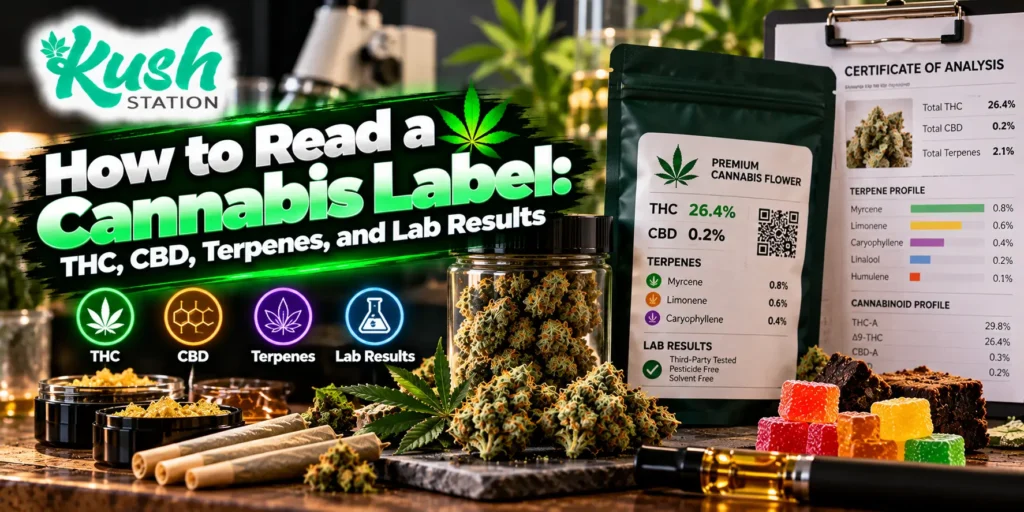
How to Read a Cannabis Label: THC, CBD, Terpenes, and Lab Results
Oct
You pick up a package of dried flower and see “THC 22%,” a strain name, a red stop-sign symbol, a lot number, and a block of small print. Another product lists “CBD 0.5 mg/g.” A third has a QR Dispensary near me now code that links to something called a certificate of analysis. If you have ever stood in front of a shelf (or scrolled a product page) wondering what all of it means, you are not alone.
Cannabis labels pack a lot of information into a small space, and most of it is useful once you know how to read it. The numbers tell you how strong a product is, the ingredients and dates tell you what is inside and how fresh it is, and the lab results tell you whether the product was tested for safety.
This guide walks through every part of a Canadian cannabis label, one piece at a time. We cover THC and CBD, the difference between THC and total THC, terpenes, dose labelling for edibles, the mandatory warnings and symbols, and how to read a lab report. By the end, you will be able to compare two products and know exactly why one suits you better than the other.
Why Reading the Label Matters
Cannabis is not one uniform product. Two jars of flower can differ hugely in potency, aroma, and effect. Two gummies can look identical and deliver very different doses. The label is your most reliable way of telling them apart.
Here is what a careful look at the label helps you do:
Control your dose. Knowing how much THC you are taking is the single best way to avoid an uncomfortable experience.
Match the product to your goal. Whether you want something mild and relaxing or something stronger for an Indica experienced palate, the numbers point the way.
Check freshness and quality. Packaged and expiry dates, storage guidance, and lab results tell you whether the product is worth buying.
Spot a legal, regulated product. Standardized symbols and warnings are required on legal products in Canada. Their absence is a red flag.
Compare products fairly. Prices, strain names, and marketing can be misleading. Label data lets you compare like with like.
What Canadian Law Requires on a Cannabis Label
Under the federal Cannabis Act and Cannabis Regulations, legal cannabis products in Canada must carry specific, standardized information. Packaging is also plain: it is restricted in colour and design, with limits on logos and branding so it does not appeal to young people. Labels vary by product category, but you will generally find:
The standardized cannabis symbol: a red stop-sign-shaped octagon with a white cannabis leaf and the letters “THC,” which signals that the product contains THC
A health warning message: one of several rotating messages, such as warnings about keeping cannabis away from children or not using it while pregnant, shown in a standardized box
THC and CBD content: shown as a percentage or in milligrams, depending on the product
Product class and type: dried cannabis, edible cannabis, cannabis extract, or topical
Brand and producer information: the licensed producer’s name and contact details
Lot or batch number: used to track the product and, if needed, recall it
Packaged-on date and expiry or best-before date: so you know how fresh the product is
Net quantity: the weight, volume, or number of units
Ingredients and allergens: for edibles, beverages, and extracts
Don’t memorize all of this. Just remember the basic rule: a legal Canadian cannabis product will have the red symbol, a health warning, THC and CBD content, a lot number, and dates. If a product claiming to be cannabis has none of these, do not buy it.
Note: Packaging requirements are updated from time to time, so check Health Canada’s website for the most current rules. [Insert any store-specific compliance details here.]
The Cannabis Symbol and Health Warnings
The first thing you will notice on a package is the red octagon with the white leaf. It is intentionally bold and consistent across every legal product in Canada. Its job is simple: warn that the contents contain THC and are intended for adults only.
Next to it, you will see a health warning message in a bordered box. These messages rotate across products and cover topics such as:
Keeping cannabis out of reach of children and pets
The risks of using cannabis while pregnant or breastfeeding
The risks of impaired driving
The risks of cannabis use for people under 25, whose brains are still developing
Possible mental health risks and the risk of dependence
These messages are not marketing. They are there so you can make an informed choice, and reading them is worthwhile, especially if you are new to cannabis.
THC Explained: What the Percentage Really Means
THC (tetrahydrocannabinol) is the main compound that produces the “high.” It is the number most people look at first, and for good reason: it is a decent indicator of how strong a product will feel.
THC on dried flower
On dried flower and pre-rolls, THC is usually shown as a percentage by weight, or in milligrams per gram (mg/g). The two are directly related. A product with 20% THC contains about 200 mg of THC per gram. Here is a quick conversion:
| THC Percentage | THC per Gram |
| 10% | about 100 mg/g |
| 15% | about 150 mg/g |
| 20% | about 200 mg/g |
| 25% | about 250 mg/g |
| 30% | about 300 mg/g |
You will often see a range, such as “THC 18 to 24%.” That is because natural plant products vary from bud to bud. The regulations allow a certain margin of variation between the labelled value and the tested value, so the number on the package is a close estimate, not an exact guarantee.
What counts as “low,” “moderate,” and “high” THC?
There is no official scale, but the following is a practical rule of thumb for dried flower:
| Level | Typical THC Range | Who It Suits |
| Low | Under about 12% | Beginners, people with low tolerance |
| Moderate | About 12 to 20% | Occasional users, those with some experience |
| High | About 20 to 25% | Regular users |
| Very high | Over about 25% | Experienced users with high tolerance |
These are general guidelines, not strict categories. Your own tolerance, body weight, metabolism, and the way you consume all affect the result.
A higher number is not always better
Many beginners assume the highest THC percentage is the best product. In practice, it is not that simple. A few reasons:
Terpenes and minor cannabinoids shape the experience. Two products with identical THC can feel quite different.
Stronger is not smoother. Very high THC can feel overwhelming, anxious, or sedating, especially for newer users.
Price often tracks the percentage, not the quality. A pricey 30% product is not automatically better than a well-grown 20% one.
Flavour and freshness matter. A fresh, aromatic 18% flower can be more enjoyable than a dull, dry 26% one.
If you are new, a moderate THC product is often the most comfortable place to start.
THC vs. Total THC: The Detail Most People Miss
Here is a subtle but important point. Raw cannabis flower contains very little active THC. Most of it is in the form of THCA (tetrahydrocannabinolic acid), a non-intoxicating precursor. When cannabis is heated, by smoking, vaping, or cooking, THCA converts into THC through a process called decarboxylation.
Because of this, Canadian labels report total THC, which accounts for the THCA that will turn into THC when heated. The usual calculation is:
Total THC = THC + (THCA × 0.877)
The 0.877 factor reflects the fact that some mass is lost in the conversion. In a lab report, you may see THC, THCA, and total THC listed separately. Don’t worry if the individual numbers look odd. A flower might show 1% THC and 24% THCA, which adds up to a total of around 22%. The total is what matters for how it will feel when you use it.
The same applies to CBD, which has a precursor called CBDA. Labels show total CBD in the same way.
CBD Explained: The Balancing Cannabinoid
CBD (cannabidiol) is the other major cannabinoid on most labels. It does not cause a high. Many people choose products with CBD for a calmer, gentler experience, and some use it to soften the intensity of THC.
How to read a CBD number
CBD appears the same way as THC: a percentage on flower, or milligrams on edibles, oils, and capsules. You will see products fall into three broad groups.
| Product Type | Typical Profile | General Idea |
| THC-dominant | High THC, little or no CBD | Stronger, more psychoactive |
| Balanced | Similar THC and CBD | Milder, more even experience |
| CBD-dominant | High CBD, low or no THC | Little to no high |
THC-to-CBD ratios
Some products highlight the ratio between the two, such as 1:1 or 2:1. A 1:1 product has equal parts of each, while a 20:1 product is mostly THC. For newcomers, a balanced ratio such as 1:1 is a popular, comfortable starting point.
Keep in mind that CBD does not cancel out THC completely. It may take the edge off, but a high-dose THC product with some CBD is still a strong product.
Minor Cannabinoids You Might See
Beyond THC and CBD, some labels and lab reports list additional cannabinoids. The ones you are most likely to encounter:
CBG (cannabigerol): often called the “mother cannabinoid” because other cannabinoids form from its acid precursor. It is non-intoxicating and increasingly popular.
CBN (cannabinol): forms as THC ages and breaks down. It is mildly intoxicating and is often marketed for evening use, though research is still limited.
CBC (cannabichromene): a non-intoxicating cannabinoid found in smaller amounts.
THCV (tetrahydrocannabivarin): a less common compound that is similar to THC but behaves differently.
These compounds usually appear in small amounts. Think of them as supporting players, not headliners. Their individual effects are still being studied, so treat any bold claims on marketing material with healthy skepticism.
Terpenes: Where Flavour and Aroma Come From
Terpenes are aromatic compounds found in many plants, from lavender and pine to citrus peels and black pepper. In cannabis, they give each strain its distinctive smell and taste. They may also influence how a strain feels, which is why two products with identical THC and CBD levels can feel noticeably different.
Common cannabis terpenes
| Terpene | Aroma and Flavour | Also Found In |
| Myrcene | Earthy, musky, fruity | Mangoes, hops, thyme |
| Limonene | Bright citrus | Lemon and orange peels |
| Beta-caryophyllene | Spicy, peppery | Black pepper, cloves |
| Linalool | Floral, lavender | Lavender, coriander |
| Alpha-pinene | Fresh pine | Pine needles, rosemary |
| Humulene | Woody, earthy | Hops, sage |
| Terpinolene | Fresh, herbal, piney | Apples, nutmeg, lilac |
| Ocimene | Sweet, herbal, fruity | Basil, mint |
Do terpenes change the effect?
This is one of the most debated topics in cannabis. Many people believe terpenes work together with cannabinoids to shape the experience, an idea often called the “entourage effect.” Some research hints at interactions, but the science is still developing, and no one can promise that a certain terpene will deliver a certain feeling. Terpenes are best used as a guide to flavour and personal preference: if you enjoy a particular profile, look for more products with a similar one.
Where to find terpene information
Terpene reporting is not required on every product label in Canada, so you may find it in different places: on the front of the package, on the producer’s website, on the retailer’s product page, or in the lab report. Some labels list only the top few terpenes, while a full lab report may list a dozen or more. If terpenes are important to you, check the product page or lab results rather than relying on the packaging alone.
A practical tip: trust your nose. If you can smell the flower, a strong, pleasant aroma usually signals a well-cured, fresh product. A faint, hay-like smell can suggest old or poorly stored flower.
Reading Labels on Different Product Types
The label looks a little different depending on what you are buying. Here is how to read each category.
Dried flower and pre-rolls
Look for:
Total THC and total CBD as a percentage or mg/g
Net weight (for example, 3.5 g or 7 g)
The strain name and type (indica, sativa, or hybrid)
Packaged-on and best-before dates
Lot number
Producer name and contact information
Tip: For pre-rolls, check the total weight and number of joints. A pack of three 0.5 g pre-rolls holds 1.5 g in total, which helps when you are comparing prices to loose flower.
Edibles
Edibles are measured differently. Instead of a percentage, the label gives milligrams of THC per package and often per piece. In Canada, edible cannabis products are limited to 10 mg of THC per package, which limits how strong a single purchase can be.
Look for:
THC in mg per piece and total per package
Serving size and number of servings
Ingredient list and allergen information
Storage instructions
Expiry date
| Dose (THC) | Level | Who It Suits |
| 1 to 2.5 mg | Microdose | First-timers and very low tolerance |
| 2.5 to 5 mg | Low | Beginners |
| 5 to 10 mg | Moderate | Occasional users |
| 10+ mg | High | Experienced users |
Reminder: edibles can take 30 minutes to two hours to take effect and last for many hours. Wait at least two hours before taking more.
Beverages
Cannabis drinks are labelled in milligrams of THC and CBD per container, within the same 10 mg per package limit for edible products. Check the ingredient list, sugar content, and any caffeine. Many people find drinks take effect faster than gummies, but it varies, so start with a low dose.
Oils and capsules (ingestible extracts)
These show THC and CBD in milligrams per millilitre (for oils) or per capsule. Pay attention to the per dose amount rather than the total in the bottle, since a bottle may contain many doses. Look at the serving size, the carrier oil used, and the total volume.
Vape cartridges and inhaled extracts
Vape labels show THC and CBD as a percentage or milligrams per gram, along with total volume. Check the ingredients for any added terpenes or other additives. Concentrates are very potent, often over 60% THC, so they call for small amounts.
Concentrates and hash
Potency is generally listed as a percentage. Because these products are strong, even a small amount can be overwhelming for a beginner. Look at the type (shatter, wax, live resin, rosin, hash), the total THC, and the weight.
Topicals
Topical products, such as creams, balms, and patches, show THC and CBD in milligrams per package. Topicals are generally applied to the skin and are not meant to be intoxicating, but follow the product’s instructions.
Dates and Freshness: Packaged-On and Best-Before
Cannabis is a plant product, and it does not last forever. Over time, THC slowly degrades into CBN, terpenes evaporate, and flower dries out and loses flavour.
On dried flower, look at the packaged-on date. Fresher is generally better, and flower within a few months of packaging usually has stronger aroma and flavour. For edibles and beverages, check the best-before or expiry date, as you would with any food product.
If a retailer does not show the packaged or expiry date online, ask. Reputable stores are happy to tell you.
Lot Numbers and Traceability
The lot or batch number looks like a boring string of characters, but it matters. It connects your product to a specific production run, and that connection makes several things possible:
Matching lab results to your product. The certificate of analysis refers to a specific lot.
Recalls. If a problem is found, the producer can identify and recall the affected batch.
Tracking consistency. If you love one batch, you can look for the same strain from the same producer and compare lot results.
Keep a note of the lot number if you like a product. It is also useful if you need to report a problem.
Understanding Lab Results: How to Read a Certificate of Analysis
Many people find the lab report, officially called a certificate of analysis (COA), the most intimidating part of cannabis shopping. It does not have to be. Think of it as a report card for a specific batch of cannabis.
Why lab testing matters
Legal cannabis in Canada must meet Health Canada’s quality and safety requirements. Licensed producers test their products, and a COA documents the results. Testing is how the industry checks that:
The cannabinoid content matches the label
The product is free from harmful contaminants
The product meets quality standards
Where to find a COA
Depending on the producer and retailer, you may find the COA:
On the retailer’s product page, as a downloadable file
Through a QR code on the packaging
On the producer’s website, searchable by lot number
On request from customer support
If none of these exist, ask. A transparent store will point you in the right direction.
What a COA usually includes
| Section | What It Shows | What to Look For |
| Product and lot details | Strain, lot number, test dates | The lot number matches your package |
| Cannabinoid profile | THC, THCA, CBD, CBDA, minor cannabinoids | Total THC and CBD close to the label |
| Terpene profile | Amounts of individual terpenes | The dominant terpenes and their percentages |
| Microbial testing | Yeast, mould, bacteria | Results within accepted limits |
| Pesticide testing | Residues of pesticides | Not detected, or below limits |
| Heavy metals | Lead, arsenic, cadmium, mercury | Below limits |
| Residual solvents | Leftover extraction solvents (extracts) | Below limits |
| Moisture / water activity | Dryness and storage stability | Within a normal range |
Key terms on a lab report
ND (not detected): the substance was not found at or above the lab’s detection limit.
LOQ (limit of quantitation): the lowest amount the lab can measure reliably.
Pass / fail: whether the sample met the set limits for that test.
mg/g or %: the unit used for each compound. Divide mg/g by 10 to get a percentage.
Method: the testing method used, often listed beside each test.
How to check the lab itself
A COA is only as trustworthy as the lab behind it. Look for a lab that is accredited, which means an independent body has verified its methods and competence. A report that lists the lab name, accreditation, test dates, and signature carries more weight than an unsigned, unlabelled document.
Red flags on lab results
No lot number, or a lot number that does not match your product
Missing sections, such as a report with only potency and no contaminant testing
A THC value far off from what the label claims
No lab name or accreditation information
Test dates that are very old
If something looks off, contact the retailer or producer before you buy or use the product.
Putting It All Together: A Step-by-Step Label Check
Here is a simple routine you can use every time you shop.
Confirm it is a legal product. Look for the red symbol, the health warning, and the producer information.
Check total THC and CBD. Decide whether the numbers fit your goal and experience level.
Read the product type and net quantity. Make sure you are comparing weights and doses fairly.
Look at the dates. Choose recent packaged-on dates and unexpired best-before dates.
Scan the terpenes or flavour notes. Choose profiles you enjoy.
Check the ingredients. For edibles and vapes, read the full list, especially if you have allergies.
Find the lot number and COA. Take a minute to look at the lab results if they are available.
Compare price per gram or per mg. Use the label data to see which product offers better value.
A worked example
Imagine you are comparing two flowers.
| Product A | Product B | |
| Total THC | 26% | 19% |
| Total CBD | Less than 1% | Less than 1% |
| Dominant terpenes | Not listed | Limonene, caryophyllene, myrcene |
| Packaged on | 7 months ago | 3 weeks ago |
| COA available | No | Yes |
| Price per gram | Higher | Lower |
Product A has higher THC, but you can’t see its terpenes, it is older, and there are no lab results. Product B has moderate THC, a clear aroma profile, is fresher, has test results, and costs less. For most buyers, especially beginners, Product B is the smarter choice.
Common Label Mistakes to Avoid
Chasing the highest THC. Potency is only one part of the experience.
Confusing mg and %. A 10 mg edible and a 10% flower are completely different measurements.
Ignoring serving size. An edible package may contain several servings, so check the per-piece dose.
Overlooking the date. Old flower can taste harsh and feel flat.
Assuming strain names guarantee consistency. The same strain name from different producers, or even different batches, can differ in potency and aroma.
Skipping the health warning. It is there for a reason, especially if you are new to cannabis or take medication.
Trusting marketing language over data. Words like “premium,” “AAAA,” or “craft” are not regulated quality grades. Look at the numbers and the lab results instead.
Storing Your Cannabis After You Read the Label
Once you have chosen well, protect your investment. Store flower in an airtight glass jar in a cool, dark place. Keep edibles in their original packaging and away from regular snacks. Keep concentrates, vapes, and everything else out of direct heat and sunlight. Above all, store every product where children and pets cannot reach it.
Frequently Asked Questions
What does THC percentage mean on cannabis?
It is the weight of THC compared with the total weight of the product. A product with 20% THC contains about 200 mg of THC per gram.
What is the difference between THC and total THC?
Raw flower contains mostly THCA, which converts into THC when heated. Total THC combines the two using a standard formula (THC plus THCA multiplied by 0.877), so it reflects the amount you will actually get when you smoke, vape, or cook the product.
Is higher THC always better?
No. Higher THC means a stronger product, but not necessarily a better experience. Terpenes, freshness, your tolerance, and your goals all matter. Many people prefer moderate THC.
What does CBD do on a cannabis label?
CBD is a non-intoxicating cannabinoid. Many people look for it to balance THC for a milder experience, and some prefer CBD-dominant products for little or no high.
Do terpenes have to be on the label?
Not on every product. Terpene information is often provided on the retailer’s page or in the lab report instead, so check there if it matters to you.
How strong is a 10 mg edible?
For many people, 10 mg of THC is a moderate to high dose. Beginners are usually advised to start with 2.5 to 5 mg, and to wait at least two hours before taking more.
What is a certificate of analysis (COA)?
A COA is a lab report for a specific batch. It shows the cannabinoid content and the results of safety tests for contaminants such as pesticides, heavy metals, and microbes.
How do I know if the lab results are real?
Check that the lot number matches your product, that the lab is named and accredited, and that the report includes dates and a full set of tests. If anything is missing, ask the retailer.
How can I tell if my cannabis is fresh?
Check the packaged-on date, and use your senses. Fresh flower smells aromatic, feels slightly springy, and breaks apart without turning to dust.
Why does the same strain feel different between producers?
Growing conditions, genetics, harvest timing, curing, and storage all affect the final product. That is why the label and lab results of each batch matter more than the strain name alone.
Final Thoughts: Let the Label Work for You
A cannabis label is not a puzzle to be solved. It is a tool that helps you buy with confidence. Start with the basics: the red symbol, the health warning, and the THC and CBD content. Add in the dates, the terpenes, and the lot number. When you want to go a step further, open the lab report and see for yourself what is inside.