
Blog 2026
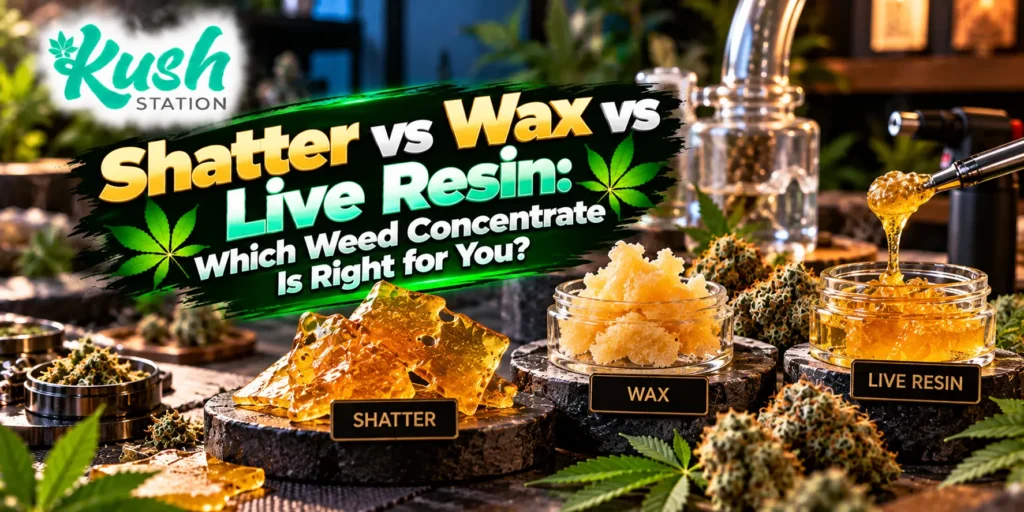
Shatter vs Wax vs Live Resin: Which Weed Concentrate Is Right for You?
Oct
Walk up to the concentrate section of any cannabis menu and you will see a lineup of names that can feel like a foreign language: shatter, wax, budder, badder, crumble, live resin, sauce, diamonds. Prices vary. Photos look similar. Everything claims to be “potent.”
If you have been wondering which weed concentrate is right for you, this guide breaks it down. We focus on the three names that come up most often, shatter, wax and live resin, and explain how each is Cannabis store near me made, how it looks, smells and tastes, how strong it is and who it suits best. We also cover how to use THC concentrates responsibly, how to store them and what to look for when you buy online in Canada.
Whether you are a flower smoker curious about stepping up or a seasoned dabber looking to explore new textures and flavours, you will find a clear answer here.
What Are Weed Concentrates?
Weed concentrates, also called THC concentrates or cannabis extracts, are products made by separating the most desirable compounds of the cannabis plant from the raw plant material. Those compounds are mainly cannabinoids such as THC and CBD, and terpenes, the aromatic molecules that give each strain its smell and flavour.
The starting point is the plant’s trichomes, the tiny resin glands that cover the flower. Extraction collects what is inside them and leaves behind most of the leafy, fibrous material. The result is a dense product that is far stronger than flower.
| Dried Flower | Concentrates | |
| Typical THC | 15% to 28% | 60% to 90%+ |
| How it is consumed | Smoked or vaporized | Dabbed, vaporized or added to flower |
| Dose per use | Larger amount | Very small amount |
| Best for | Beginners and everyday use | Experienced consumers |
That jump in potency is the most important thing to understand before you buy. A very small amount of concentrate can produce a much stronger effect than a full joint.
How Concentrates Are Made
Shatter, wax and live resin are usually made with a hydrocarbon extraction, where cannabis is washed with a solvent such as butane or propane to dissolve the cannabinoids and terpenes. The solvent is then carefully removed, or “purged,” in a controlled process, typically using gentle heat and a vacuum. In licensed production, the finished product is tested to confirm that residual solvents fall below legal limits.
Other common methods include:
CO2 extraction. Pressurized carbon dioxide is used as the solvent. Common for oils and vape cartridges.
Ethanol extraction. Alcohol pulls out compounds, often for large-scale production.
Solventless extraction. Heat, pressure, ice water and mechanical separation, with no chemical solvents. Rosin and bubble hash are the best-known examples.
What separates shatter, wax and live resin from each other comes down to two things:
The starting material. Dried and cured cannabis, or fresh-frozen plants.
How the extract is handled after extraction. Left undisturbed, or whipped and agitated.
Keep those two ideas in mind and the rest of this guide will make sense.
Shatter: The Glass-Like Classic
What Is Shatter?
Shatter is a translucent, amber-coloured concentrate with the look and feel of hard candy or stained glass. Snap a piece and it breaks with a clean, glassy crack, which is how it earned its name.
How Shatter Is Made
After extraction, the oil is poured onto parchment and purged under low heat and vacuum, usually without stirring or whipping. Because it is left undisturbed, the extract sets into a stable, glass-like state. Producers often filter the extract more Cannabis near me heavily to remove fats and waxes that would cloud the final product, which is why shatter tends to look so clear.
What Shatter Looks, Smells and Tastes Like
Appearance: Transparent to translucent, usually golden or amber.
Texture: Hard and brittle at room temperature. It can soften in warm hands.
Flavour: Mild. The extended purging and refining tends to reduce terpenes, so you may get only a hint of the strain’s character.
Aroma: Light compared to live resin.
How Strong Is Shatter?
Shatter commonly tests between 70% and 90% THC. It is valued for raw potency rather than flavour.
Shatter Pros and Cons
| Pros | Cons |
| High THC for the price | Lower terpene content and milder flavour |
| Stable and long-lasting when stored well | Brittle and can shard when handled |
| Easy to see a clean, uniform look | Harder to portion into tiny doses |
| Often one of the more affordable options | Less common than it once was |
A word of caution: A clear, glassy look does not automatically mean a product is clean or safe. Only lab testing can confirm what is in a product, so always check the product page for test information. [Add a link to your lab testing or quality assurance page here.]
Wax: A Family of Soft, Whipped Concentrates
What Is Wax?
“Wax” is both a product and an umbrella term. In everyday use it describes a soft, opaque concentrate with a texture somewhere between candle wax, frosting and crumbled cake. You will see several names on menus:
| Name | Texture |
| Wax | General term for a soft, opaque, pliable concentrate |
| Budder / butter | Smooth and creamy, like cake frosting |
| Badder / batter | Similar to budder, but even smoother and more uniform |
| Crumble | Dry and brittle, falls apart into pieces |
| Sugar | Wet and granular, like coarse crystals in a thick sauce |
| Honeycomb | Light, airy and bubbly |
These names are not strictly regulated, and producers sometimes use them loosely. In general, they describe texture.
How Wax Is Made
Wax starts with the same extraction as shatter, but the oil is agitated or whipped during the purge. Stirring introduces air and changes how the molecules arrange themselves, creating an opaque, whipped consistency instead of a transparent sheet. Moisture, temperature and the starting material also play a role. The same extract could become shatter, badder or crumble depending purely on how it is handled.
What Wax Looks, Smells and Tastes Like
Appearance: Opaque, usually cream, pale yellow or golden.
Texture: Ranges from creamy and spreadable to dry and crumbly.
Flavour: Moderate. Many waxes keep more terpenes than shatter, so the taste is typically richer.
Aroma: Noticeable, though usually less vivid than live resin.
How Strong Is Wax?
Wax commonly tests between 60% and 85% THC. A slightly lower-THC wax with plenty of terpenes can feel more satisfying than a higher-THC product with little flavour.
Wax Pros and Cons
| Pros | Cons |
| Better flavour than most shatter | Less stable than shatter in heat and humidity |
| Easy to scoop and portion (budder and badder) | Can be sticky or crumbly and messy to handle |
| Wide range of textures and price points | Labelling is inconsistent between brands |
| Works for dabbing and as a flower topper | Texture can change if stored poorly |
Live Resin: The Flavour-First Concentrate
What Is Live Resin?
Live resin is defined less by how it looks and more by what it is made from. Instead of using dried and cured cannabis, producers use plants that are flash-frozen right after harvest. Because the plant never goes through drying and curing, far more of its volatile terpenes survive, and terpenes are what give cannabis its aroma and flavour.
Live resin often comes as a sauce, a wet, glistening, syrupy consistency that sometimes contains crystalline THCA “diamonds.” It can also be sold as budder, badder or sugar. In other words, shatter and wax are mostly texture labels, while live resin is mostly a starting material label. A live resin product can have a wax-like texture.
How Live Resin Is Made
Harvest and freeze. Fresh plants are cut and frozen immediately to lock in volatile compounds.
Cold extraction. The frozen plant is washed with a very cold solvent. Staying cold helps preserve terpenes and limits unwanted plant material like chlorophyll.
Low-temperature purge. The solvent is removed at low heat, since high temperatures would destroy the aromatics the process is designed to capture.
The result is an extract that smells and tastes much more like the living plant.
What Live Resin Looks, Smells and Tastes Like
Appearance: Saucy, sticky or sugary, from pale gold to deep amber.
Texture: Runny to thick, sometimes with visible crystals.
Flavour: Vivid and complex. Expect notes like citrus, pine, berry, diesel or sweet dessert flavours, depending on the strain.
Aroma: Strong and fresh, often the closest thing to smelling a perfect bud.
How Strong Is Live Resin?
Live resin typically tests between 60% and 80% THC, with terpene content that is often much higher than in shatter or standard wax. A lower THC number than shatter does not mean a weaker experience. Fans often describe live resin as rounder and more nuanced, in part because more of the plant’s aromatic compounds are preserved. Researchers are still studying how cannabinoids and terpenes interact, sometimes called the “entourage effect,” so treat claims about this with some caution.
Live Resin Pros and Cons
| Pros | Cons |
| Outstanding flavour and aroma | Usually the most expensive of the three |
| Strain-specific character | Less shelf-stable, often best kept cool |
| Popular in high-quality vape cartridges | Sticky and harder to handle |
| Broader range of plant compounds | “Live resin” quality varies between brands |
Shatter vs Wax vs Live Resin: Side-by-Side Comparison
| Feature | Shatter | Wax (Budder, Badder, Crumble) | Live Resin |
| Defined by | Glassy texture | Opaque, whipped texture | Fresh-frozen starting material |
| Appearance | Translucent, amber, hard | Opaque, cream to gold | Saucy, sticky, sometimes crystalline |
| Typical THC | 70% to 90% | 60% to 85% | 60% to 80% |
| Terpene content | Low | Moderate | High |
| Flavour | Mild | Moderate | Rich and vivid |
| Handling | Brittle, can shard | Workable but can be sticky | Sticky and runny |
| Stability | High | Moderate | Lower, often kept cool |
| Typical price | Lower to moderate | Moderate | Moderate to highest |
| Best for | Potency and value | All-rounders | Flavour lovers |
These ranges are general. Individual products vary a lot, so always check the lab results and product details on the page.
How Do the Effects Compare?
All three concentrates deliver THC quickly and intensely, especially when vaporized. Onset is typically within seconds to a couple of minutes, which is faster and sharper than edibles and usually stronger than smoking flower. The core effects (euphoria, relaxation, altered perception, increased appetite and, for some people, anxiety or paranoia) are shared across all three.
The differences are more subtle:
Shatter tends to be described as a strong, clean and straightforward hit with very little flavour to distract from the effect.
Wax sits in the middle, with a strong hit and a decent flavour profile.
Live resin is often described as more nuanced, with the strain’s terpene profile shaping the character of the experience.
It is worth being honest here. Much of what people report about differences in effect is subjective. Tolerance, dose, mood, setting and expectation matter at least as much as the product type. The most reliable differences you will notice are flavour, potency and handling.
How to Use Concentrates
Dab Rigs
The traditional method. A small glass water pipe has a heated surface (a nail or banger) onto which you place a tiny amount of concentrate, called a dab. It vaporizes and you inhale. This delivers the most intense hit and works with all three products.
Electronic Rigs and Dab Pens
Battery-powered devices heat the concentrate to a set temperature without a torch. They are more portable and controlled, and temperature control is especially helpful for terpene-rich products like live resin.
Vape Cartridges
Many cartridges use distillate, CO2 oil or live resin. If you want convenience and flavour, a live resin cartridge can be an easy way into the category. Make sure the cartridge fits your battery.
Flower Toppers
A small amount of wax or shatter can be added to the top of a bowl or joint to boost strength. It is simple and requires no extra equipment, but it is harder to control the dose.
Temperature Matters
| Temperature Range | What to Expect |
| Lower (about 450°F to 600°F / 230°C to 315°C) | Smoother vapour and better flavour. Ideal for live resin. |
| Higher (above about 600°F / 315°C) | Thicker clouds, harsher hit, flavour burns off. Can irritate the throat and lungs. |
Shatter has fewer terpenes to lose, so it tolerates slightly higher heat, but cooler is generally smoother for everything.
Which Concentrate Is Right for You?
The best choice depends on what matters most to you.
| If You Want… | Choose | Why |
| The best flavour and aroma | Live resin | Fresh-frozen processing preserves terpenes |
| Maximum THC for your money | Shatter or crumble | High potency at a lower cost |
| Easy handling | Budder or badder | Scoops cleanly and stays put |
| Long storage or travel within Canada | Shatter | The most stable of the three |
| A balanced all-rounder | Wax | Good flavour, workable texture, fair price |
| A smoke-free, portable option | Live resin cartridge | Convenient and flavourful |
If You Are New to Concentrates
A serious point first: concentrates are not a beginner product. If you have never used cannabis, start with flower or a low-dose edible and learn how your body responds. If you are comfortable with flower and want to try concentrates, begin with a very small amount, roughly the size of a grain of rice or smaller, and wait several minutes before deciding whether to take more. A temperature-controlled e-rig or a low-dose cartridge is usually gentler than a torch-heated dab.
Among the three, a budder or badder is the easiest to handle, and live resin tends to be the most enjoyable to learn on because of its flavour, as long as you keep the dose small.
If You Want to Explore
Order a small amount of two or three types from the same trusted source and compare them. Keep notes on the strain, texture, temperature and how you felt. After a couple of orders, you will know what you like.
How to Buy Weed Concentrates Online in Canada
Buying concentrates online gives you a much wider selection than most local shops, along with detailed product pages, clear pricing and discreet delivery. Here is what to check before you order.
Read the Product Page Carefully
Look for:
Strain name and type (indica, sativa or hybrid)
THC and CBD percentages
Terpene information, especially for live resin
Extraction method and texture (shatter, badder, sauce, and so on)
Lab test results, including residual solvents, pesticides and heavy metals
Weight options and clear pricing
Check the Store
| What to Check | A Good Store | Red Flag |
| Age verification | Verifies you are of legal age | No age check at all |
| Product information | Accurate potency, strain and photos | Vague or missing details |
| Testing | Shares lab results or quality information | No testing information |
| Pricing and policies | Clear shipping costs and delivery times | Hidden fees at checkout |
| Checkout | Secure HTTPS and reputable payment options | Unsecured pages |
| Support | Real contact details and responsive help | No way to reach anyone |
At Kush Station, we aim to meet each of these standards. [Add what makes Kush Station different: selection size, sourcing, quality control, customer service, loyalty rewards, guarantees and so on.] [Link to your concentrates category page here.]
What to Expect from Delivery
Timing. Delivery times vary by location. Check the estimate at checkout.
Packaging. Cannabis products are required to be in child-resistant packaging, and most orders arrive in plain, discreet outer packaging.
ID check. You must be of legal age to receive your order. Make sure someone of legal age is available to accept the package and show ID if asked.
[Add Kush Station’s delivery areas, typical timeframes, shipping cost, free-shipping threshold and accepted payment methods here.]
Is It Legal to Buy Concentrates in Canada?
Under the federal Cannabis Act, adults of legal age can buy, possess and use cannabis products, including extracts such as concentrates. Each province and territory sets its own rules for retail and online sales.
Age limits. The minimum age is 19 in most provinces and territories, 18 in Alberta and 21 in Quebec.
Possession limits. Adults can generally carry up to the equivalent of 30 grams of dried cannabis in public. Concentrates count at a different ratio than flower, so a much smaller weight of concentrate reaches that limit. Check the current federal equivalency table and your provincial rules.
Provincial rules. Regulations on retail, delivery and where you can consume vary by location.
Borders. Do not travel internationally with cannabis. It is illegal to take it across the Canadian border in either direction.
Laws change, so always check your provincial government’s website for current rules. Kush Station is committed to operating responsibly and serving only customers of legal age. [Add your licensing and compliance details here so readers can see exactly how you operate.]
Safety, Dosing and Storage
Respect the Potency
High-THC products carry real risks, especially for new or occasional users. These can include intense anxiety, panic, a racing heart, nausea, dizziness and, in some cases, temporary paranoia or disorientation. Research links frequent use of high-potency cannabis with a higher risk of cannabis use disorder, and some studies link it with a higher risk of psychosis, particularly for people who start young or who have a personal or family history of psychotic disorders. If you have a mental health condition, are pregnant or breastfeeding, or take prescription medication, speak with a doctor or pharmacist before using concentrates.
Start Low and Go Slow
Take a very small amount, wait and assess before taking more. Tolerance builds quickly with concentrates, so daily use tends to push people toward larger and larger doses. Taking breaks helps reset your tolerance.
Do Not Drive or Operate Machinery
Cannabis impairs judgment and reaction time. Plan to stay put and use concentrates in a comfortable, safe environment.
Handle Equipment Safely
Torches and hot glass can cause burns and fires. Never use a torch near flammable materials. Never attempt to make hydrocarbon extracts at home. Home butane extraction has caused serious explosions and injuries. Leave it to licensed professionals.
Store Concentrates Properly
| Product | Storage Tips |
| Shatter | Airtight container, away from heat and light |
| Wax / Budder | Airtight container, cool and dark, away from humidity |
| Live resin | Airtight glass container, ideally refrigerated to protect terpenes |
Keep all cannabis products in their original packaging, locked up or well out of reach of children and pets.
Common Myths About Concentrates
“Higher THC always means better.” Not necessarily. A 90% THC shatter with almost no terpenes may taste bland, while a 70% live resin can be far more satisfying. Potency is only one factor.
“Live resin is always stronger.” No. Live resin often tests slightly lower in THC than shatter. Its strength is in flavour and complexity.
“Shatter is the purest because it is clear.” Clarity reflects texture and processing, not purity or safety. Only lab testing can confirm what is in a product.
“Wax and shatter are completely different substances.” They are usually the same type of extract handled differently. Texture reflects processing.
“Concentrates are just fast edibles.” No. Inhaled concentrates hit within minutes and wear off sooner, while edibles take much longer to start and can last for hours. They carry different risks.
Frequently Asked Questions
What is the difference between shatter and wax?
Mostly texture and handling. Both are typically hydrocarbon extracts. Shatter is left undisturbed and sets into a hard, glassy form, while wax is whipped, giving it an opaque, soft or crumbly consistency. Wax often keeps a bit more flavour.
Is live resin better than shatter?
It depends on your priorities. Live resin offers the best flavour and aroma. Shatter often tests higher in THC, is more stable and is usually cheaper. Neither is automatically better.
Is live resin the same as rosin?
No. Live resin is usually made with a solvent from fresh-frozen plants. Rosin is solventless and made by pressing flower or hash with heat and pressure. Live rosin is a solventless product made from fresh-frozen material.
What is the difference between concentrates and hash?
Both are concentrated forms of cannabis. Hash is made by collecting and pressing the plant’s resin glands, while shatter, wax and live resin are typically made through extraction methods. Both are far stronger than regular flower.
Can I use concentrates in a regular vape pen?
Not every pen is designed for concentrates. Look for a device made for wax or concentrates, or use cartridges that match your battery. The wrong device can give poor results or damage the equipment.
Which concentrate is best for a beginner?
Ideally, none until you are comfortable with cannabis in general. If you want to try one, start with a very small amount of budder or badder, or a low-dose live resin cartridge, and use a temperature-controlled device if possible.
How long do concentrates last?
Shatter can last many months when stored properly. Wax is moderately stable. Live resin is best enjoyed sooner and kept cool. Check the packaging date and store everything away from heat and light.
Why is live resin more expensive?
Because of the process. Freezing fresh plants right after harvest, using cold extraction and carefully purging at low temperatures all add cost and labour, and yields can be lower than extractions from dried material.
Can I order concentrates if I am under 19?
No. You must be of legal age in your province or territory. That is 19 in most places, 18 in Alberta and 21 in Quebec.
Final Thoughts: Your Next Order Starts Here
Shatter, wax and live resin are not three different substances so much as three different expressions of the same plant, shaped by what goes in and how it is handled.